

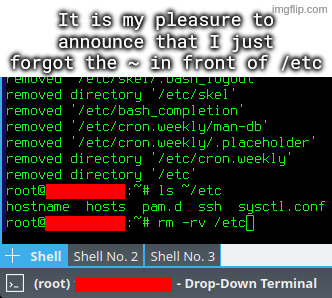
I accidentally untarred archive intended to be extracted in root directory, which among others included some files for /etc directory.
I went on to rm -rv ~/etc, but I quickly typed rm -rv /etc instead, and hit enter, while using a root account.
So good to see that, even in 2026, Unix Haters’ Handbook’s part on rm is still valid. See page 59 of the pdf
The biggest flaw with cars is when they crash. When I crash my car due to user error, because I made a small mistake, this proves that cars are dangerous. Some other vehicles like planes get around this by only allowing trusted users to do dangerous actions, why can’t cars be more like planes? /s
Always backup important data, always have the ability to restore your backups. If rm doesn’t get it, ransomware or a bad/old drive will.
A sysadmin deleting /bin is annoying, but it shouldn’t take them more than a few mins to get a fresh copy from a backup or a donor machine. Or to just be more careful instead.
There’s a reason sane programs ask for confirmation for potentially dangerous commands
True, in this case trash-cli is the sane command though, it has a much different job than rm. One is remove forever no take backs, the other is more mark for deletion. It’s good to have both options imo. Theres a lot of low level interfaces that are dangerous, if they’re not the correct tool for the job then they don’t have to be used. Trying to make every low level tool safe for all users just leads to a lot of unintended consequences and inefficiencies. Kill or IP address del can be just as bad, but netplan try or similar also exist.
Edit: nevermind, wrong section.
Btw, what’s this about QWERTY to slow them down?
Far as i know, it’s to reduce finger travel?On mechanical typewriters the little arms that slap the steel letters onto the ink ribbon/paper could get physically jammed. QWERTY was designed to make it so that was less likely to happen by placing the keys in an order that discouraged it.
At least, that’s the way I learned it.
Source: trust me bro
Qwerty was developed so that typewriter hammers have a low chance of hitting each other and get stuck. It was never about finger travel or ergonomics.
PCs adapted the layout and unfortunately we stuck with it ever since. There are many better layouts, some more extreme in terms of difference to qwerty, some just fix the most blatant problems. Colemak and Dvorak for example.