
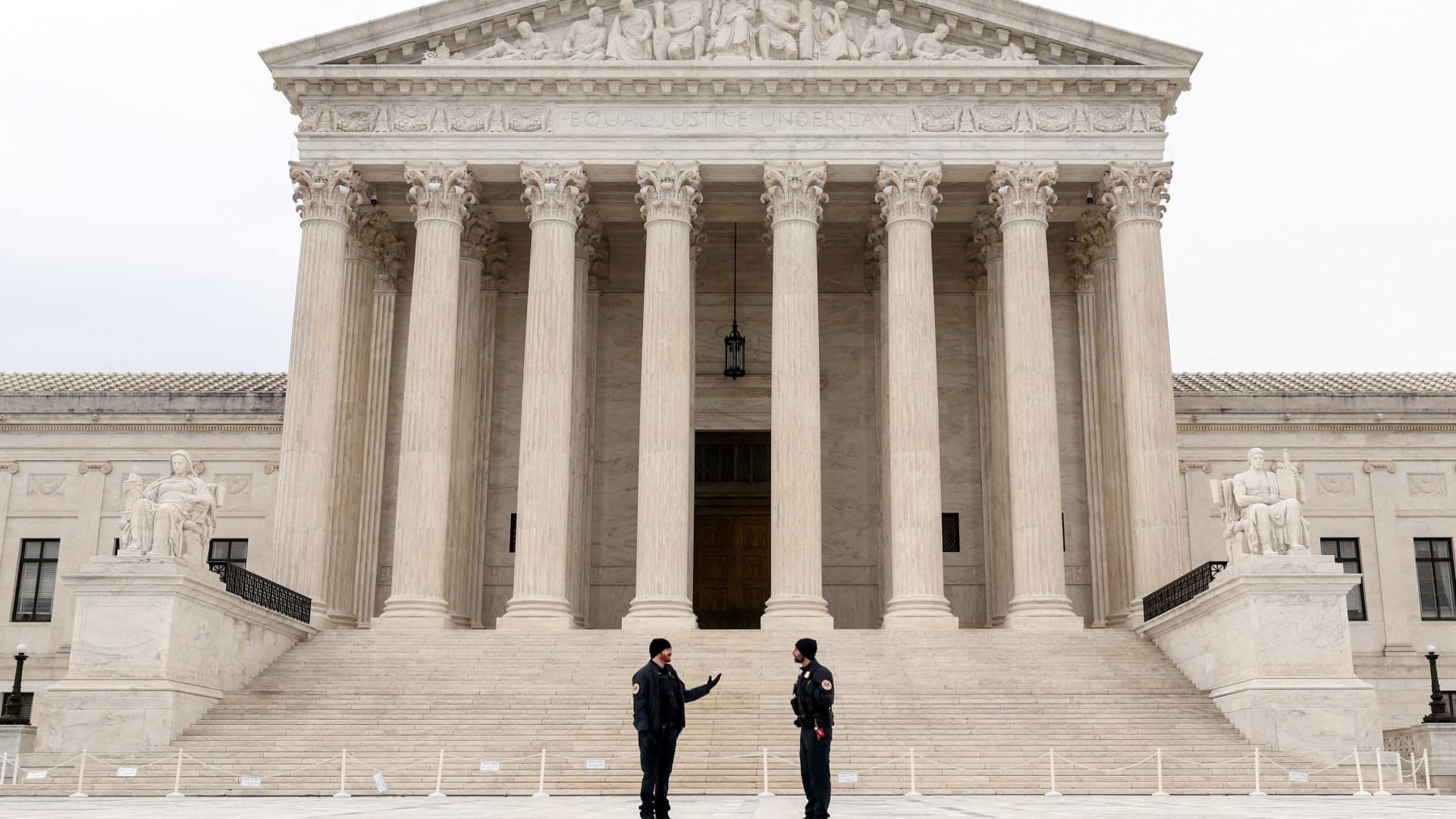
The U.S. Supreme Court declined on Monday to take up the issue of whether art generated by artificial intelligence can be copyrighted under U.S. law, turning away a case involving a computer scientist from Missouri who was denied a copyright for a piece of visual art made by his AI system.
Plaintiff Stephen Thaler had appealed to the justices after lower courts upheld a U.S. Copyright Office decision that the AI-crafted visual art at issue in the case was ineligible for copyright protection because it did not have a human creator.
Thaler, of St. Charles, Missouri, applied for a federal copyright registration in 2018 covering “A Recent Entrance to Paradise,” visual art he said his AI technology “DABUS” created. The image shows train tracks entering a portal, surrounded by what appears to be green and purple plant imagery.
The Copyright Office rejected his application in 2022, finding that creative works must have human authors to be eligible to receive a copyright. U.S. President Donald Trump’s administration had urged the Supreme Court not to hear Thaler’s appeal.
Ah, this is Thaler v. Perlmutter.
I seem to have picked up a reputation in these parts as being “pro-AI”, so I’m not sure how my view will be interpreted, but Thaler is basically a loon. This case is not really over whether AI art can be copyrighted. It’s about whether AI itself can hold copyright. ie, Thaler isn’t arguing “I hold the copyright to this piece of art.” He’s arguing “my AI holds the copyright to this piece of art.”
Since AI is not a legal person - it’s neither human nor a corporation - this is basically an open and shut case. There is no entity capable of holding copyright in this case.
Since Thaler himself is explicitly disclaiming that he holds the copyright, that means the work in question has no copyright holder. Which puts it into the public domain. This specific piece in this specific circumstance, not all AI-generated pieces.
It’s a commonly misinterpreted case.
So is he arguing that he owns the AI as a slave then and thus has control over the copyright? Because otherwise the AI would “decide” who gets to use the copyright then and it’ll probably just say yes like these things do for everything else.
Work for hire. If I hire you to create something, I own the copyright.
I honestly don’t know what his underlying reasoning is, he really seems like a loon with too much time and money on his hands to me. The only reason I pay any attention to this case is because Thaler v. Perlmutter has been coming up in headlines like this one for years now.
That seems like an unacceptable loophole. I shouldn’t be able to create derivative media and have it be legal and public domain. The unlicensed training itself is a rights violation, and and media produced from it should equally be a violation.
That is a different conversation. If we assume a legally trained AI strictly on data it was allowed to train on, they are saying the AI cannot hold copyright.
I also don’t see a loophole here, since it was denied anyway.
Well, there’s the rub - proving that AI-generated works are “derivative works” (in the legal sense).
This court case had nothing to do with that. I’m aware of a few cases that have established the opposite, that AI models and their products are not derivative works. Do you know of any that have established that they are?
There are cases where it’s been ruled fair use.