

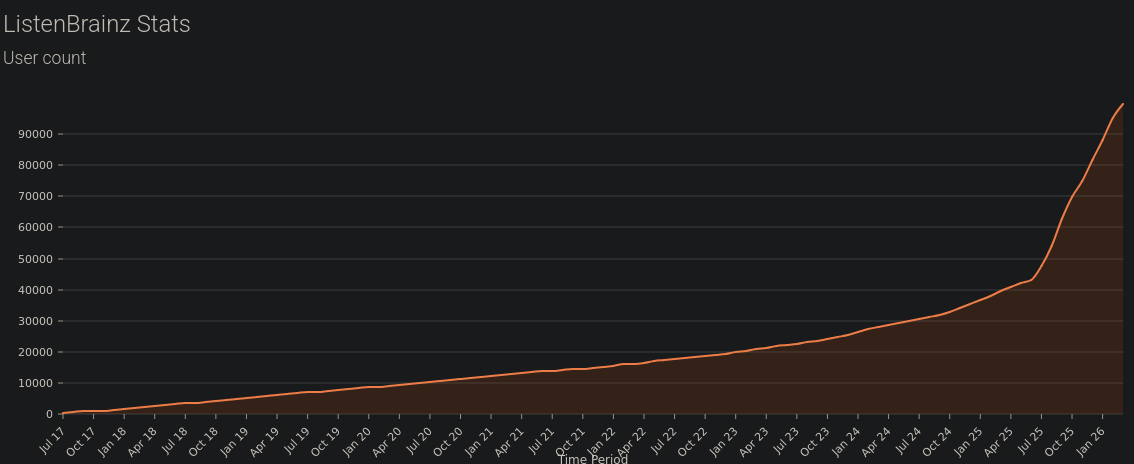
Allow me to spread the word about ListenBrainz , the occasion being that ListenBrainz is about to hit 100.000 users.
ListenBrainz is a FOSS project that aims to crowdsource listening data and release it under an open license. Basically it’s Last.fm but better. Whatever you use to listen to music, you can probably link it up with ListenBrainz. For instance you can connect Spotify, Apple Music, Soundcloud, Last.fm . You can link it up with loads of music players . If you’ve kept track of your what music you’ve listened to up to this point, don’t worry, there are several ways to import them into ListenBrainz.
All ListenBrainz listening data is available for all to use. This means that we don’t need to rely on big companies like Spotify for recommendation algorithms. We can use whatever algorithm suits us best. All sorts of other services could be build to make use of the ListenBrainz data set. The dataset can also help analyze other services’ algorithms, for instance the Fair MusE project uses LB-data and LB-users to investigate the fairness of different music service algorithms.
Obviously ListenBrainz initially suffered from being a comparatively small service, For good recommendations you need loads of data. But it’s growing every day and I feel like the 1 billion listens is an impressive milestone. And ListenBrainz has the advantage of having listening data from several services, Spotify could never recommend you music that’s not on Spotify. ListenBrainz, because it’s open, doesn’t have such inherent blindspots.
I am not working for ListenBrainz in any way, I just really like this project as well as MusicBrainz , and I like to spread the word. I think the aims of the ListenBrainz probably align with some Fediverse-folks. If you don’t care about the service itself, you could still link up to support FOSS music services, not only LB itself, but other services that are, can and will be built using LB’s data. If you use another service to store your own listening data, for instance Last.fm, you could use ListenBrainz as a backup for you data in case the other sevice ever enshittifies. Note: you shouldn’t sign up if you want your listening data to be private, that’s not what LB is for. I care very much about privacy, but in the case of LB I consciously choose to share my music listening data with others for my own benefit.
Curious to hear peoples thought on all this.
P.S. I have posted about LB over a year ago. I don’t intend to spam this service, but i feel like it could be useful for folks on here, and I think most of you folks would support the spreading of FOSS. And LBs usercount rising from 36k january last year to 100k now seemed like a good celebratory occasion to spread the love once more.
Can someone explain to a Gen x guy what “listening data” gets me? I’ve been living off a folder of mp3s for 30 years. Does this use my music? Does this get it from the Internet somewhere? How is it different from asking Alexa to play music for me? Thanks.
Same here. I love that shit. My mood is the algorithm. I still occasionally get new stuff, but from other sources I happen to see or hear, like a Netflix show that has it in the background or a musician’s personal recommendation in an interview, and I go look it up manually. But even if I never got anything new, I already have more music than I could easily listen to in a lifetime that I already know I liked at least once.
I’ve tried streaming sources, but it never hits right. This way, where I am specifically picking the artist or album, it’s always right, always fresh, and I’m always listening to something I want to hear.
It depends on your preferences, but myself I just like knowing what I listen to a lot and send my monthly cover art collage to brag about my blorbos
The player / radio are nice, but I personally created my own radio generator based on my data
I’ve been using LastFM for nearly two decades now. First of all, having personal listening statistics is kind of fun. It might be not for everybody, but it’s nice to see which albums are your most played over a year or what you listened to back in 2015, how your favorite artists changed, which album really vibed with you and so on.
Second, you can get really good recommendations for new music when you have a larger user base and are running into a smaller genres. So just like Amazon’s and people who bought this product also bought that product for music. So people who listen to Britney Spiels also like to listen to Christina Aguilera. That might be obvious for you, but it’s totally interesting if you go down some of these genres and if you want to explore them.
And on a broader scale, listening data is quite valuable to create a good music service. So if somebody never heard of a band called Deep Purple and wants to change that, there might be this one song everybody knows from Deep Purple. And this is, of course, the most popular, but how do you find out that this is the most popular? So if you have your own Jellyfin installation, you load in several albums of Deep Purple, but you need some data source to tell you that ‘smoke on the water’ is that famous song from Deep Purple that everybody’s listening to.
I love listening stats, I just don’t need to share them, and for that I have Navidrome. I use subsonic clients and a Navidrome server for my Bandcamp purchased. I get the stats and privacy too…