I don’t claim to be an expert on the endocrine system. But I know enough to know it’s the most complicated system in the body. Possibly more complicated than the brain (my area of expertise).
And only recently did scientists figure out how to high jack the endocrine system for weight loss and not without plenty of side effects.
So in order for a baby to come to term, it must be exposed to different hormones , at different levels, at different times that come from the mother.
We can’t produce all of those hormones.
We can’t even currently determine all of hormone needs of a fetus. So there is no way to meet these needs. Not to mention the protein needs. Again, many of which are made by the mother. And can’t be synthetic.
We can grow an embryo in a container for quite a while. weeks. Maybe even a few months.
Sure, you can attach it to a roomba with temperature control.
But that’s not the same as being able to grow a baby to term.
We just need something “good enough”, it doesn’t need to be fully developed, just to grow up enough to mop some floors, maybe pick some items in an amazon warehouse
All these related AI claims like “AI will cure cancer” or anything related to AI solving otherwise unsolved scientific problems are always hilarious. Curing cancer or any other disease requires us to fully understand the biological mechanisms of the disease enough to then even attempt to affect it with a drug.
AI learns and does its thing via input data from human knowledge and our current understanding. How can AI possibly gain an understanding of the disease mechanism or biological/biochemical system beyond that which humans understand? Not to mention it can’t perform any sort of experiments to even test an idea.
Sure I can appreciate it speeding up certain analyses that are otherwise tedious to do ourselves, but it’s never going to spit out some magic bullet cure
Agree. And also. Scientists have been using and running statistical software analysis since like the late 70s. Everyone acts like we don’t have tried and true methods already.
Some machine learning might be useful though in research but idk if it’s fair to call it “ai”. Idk it depends on your definition.
Actually in the research I do, I was looking into papers that measured a lot more variables than what is commonly done. (Usually two things are compared) And the authors used a formula to determine interactive effects based on which factors aligned or didn’t align and by how much.
This type of statistics is close to how ai works as it gives “weights” to different inputs.
But this was a method the authors came up with and they fully disclosed how it worked and acknowledged it was only one of many approaches to determining these interactive effects.
The research I’m referring to was about vision. Accommodation and vergence. Which function together. And you can manipulate them so they don’t match and see which one has a stronger influence on the perception of depth. However, many other factors effect depth perception. But it’s nearly impossible to study how these each contribute when multiples other factors are present. Some matching the true depth. Some giving an incorrect cue. Which cue, when wrong, overrides the correct one? If two matching cure are present, is there one cue that’s wrong, but has a stronger impact on the perception ?
These things are difficult to determine without literally thousands of studies.
The complete lack of a moral compass and legal ramifications displayed so far by the techbros might give them a very small advantage. But that shit always ends up being nothing more then useless torture in the end with little in the way of results.
The thing a lot of people don’t understand about unethical science is that it’s almost always shit science to boot.
For example I hear people say that “sure, what the Nazis scientist did to Jews was awful but we learned so much”.
No we didn’t.
The only thing that research was good for was determining how long it took for a starved stressed person to die from a specific infliction like hypothermia. Or having limbs cut off. Or having poisons injected into them.
That’s literally the only thing gained and because the test subjects themselves were already in poor condition, we can’t even use that information to determine, for instance, how long a healthy person could survive with said inflictions.
Their shit ethics is also shit science.
It’s worthless.
All those Nazi scientist who got a free get-out-of-jail card and set up in the U.S were shit scientist. They never gave the world anything useful.
Much like the research musk’s neurolink does.
They dont get published papers because it’s unethical and shit science.
Nothing useful comes from mass maiming and torturing of animals. Neurolink… I don’t even want to get into why it has so many methodology flaws. But it’s not being done properly.
Shit ethics is always shit science too.
People think letting these tech bros cross ethical restrictions will result in faster tech advances, they are sorely mistaken.
I don’t disagree with your overall point, we aren’t close to roboreproduction and it will take decades of incredibly unethical experiments to change that.
But we as a species are really really good at organic chemistry. We can make anything out of carbon and friends that God can, and many things they can’t.


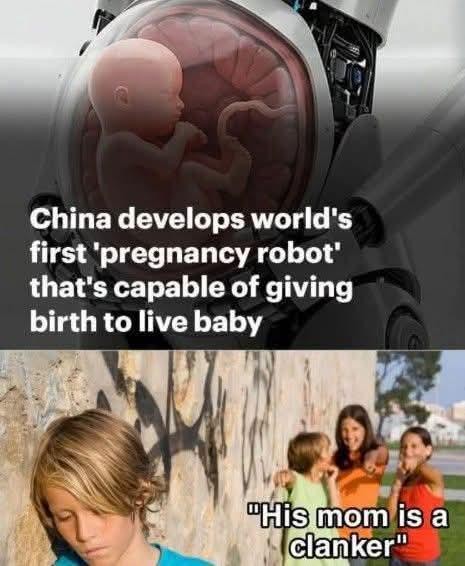
I don’t claim to be an expert on the endocrine system. But I know enough to know it’s the most complicated system in the body. Possibly more complicated than the brain (my area of expertise).
And only recently did scientists figure out how to high jack the endocrine system for weight loss and not without plenty of side effects.
So in order for a baby to come to term, it must be exposed to different hormones , at different levels, at different times that come from the mother.
We can’t produce all of those hormones. We can’t even currently determine all of hormone needs of a fetus. So there is no way to meet these needs. Not to mention the protein needs. Again, many of which are made by the mother. And can’t be synthetic.
We can grow an embryo in a container for quite a while. weeks. Maybe even a few months.
Sure, you can attach it to a roomba with temperature control.
But that’s not the same as being able to grow a baby to term.
We just need something “good enough”, it doesn’t need to be fully developed, just to grow up enough to mop some floors, maybe pick some items in an amazon warehouse
Brave New World vibes
All these related AI claims like “AI will cure cancer” or anything related to AI solving otherwise unsolved scientific problems are always hilarious. Curing cancer or any other disease requires us to fully understand the biological mechanisms of the disease enough to then even attempt to affect it with a drug.
AI learns and does its thing via input data from human knowledge and our current understanding. How can AI possibly gain an understanding of the disease mechanism or biological/biochemical system beyond that which humans understand? Not to mention it can’t perform any sort of experiments to even test an idea.
Sure I can appreciate it speeding up certain analyses that are otherwise tedious to do ourselves, but it’s never going to spit out some magic bullet cure
Agree. And also. Scientists have been using and running statistical software analysis since like the late 70s. Everyone acts like we don’t have tried and true methods already.
Some machine learning might be useful though in research but idk if it’s fair to call it “ai”. Idk it depends on your definition.
Actually in the research I do, I was looking into papers that measured a lot more variables than what is commonly done. (Usually two things are compared) And the authors used a formula to determine interactive effects based on which factors aligned or didn’t align and by how much.
This type of statistics is close to how ai works as it gives “weights” to different inputs.
But this was a method the authors came up with and they fully disclosed how it worked and acknowledged it was only one of many approaches to determining these interactive effects.
The research I’m referring to was about vision. Accommodation and vergence. Which function together. And you can manipulate them so they don’t match and see which one has a stronger influence on the perception of depth. However, many other factors effect depth perception. But it’s nearly impossible to study how these each contribute when multiples other factors are present. Some matching the true depth. Some giving an incorrect cue. Which cue, when wrong, overrides the correct one? If two matching cure are present, is there one cue that’s wrong, but has a stronger impact on the perception ?
These things are difficult to determine without literally thousands of studies.
The complete lack of a moral compass and legal ramifications displayed so far by the techbros might give them a very small advantage. But that shit always ends up being nothing more then useless torture in the end with little in the way of results.
Absolutely.
The thing a lot of people don’t understand about unethical science is that it’s almost always shit science to boot.
For example I hear people say that “sure, what the Nazis scientist did to Jews was awful but we learned so much”.
No we didn’t.
The only thing that research was good for was determining how long it took for a starved stressed person to die from a specific infliction like hypothermia. Or having limbs cut off. Or having poisons injected into them.
That’s literally the only thing gained and because the test subjects themselves were already in poor condition, we can’t even use that information to determine, for instance, how long a healthy person could survive with said inflictions.
Their shit ethics is also shit science.
It’s worthless.
All those Nazi scientist who got a free get-out-of-jail card and set up in the U.S were shit scientist. They never gave the world anything useful.
Much like the research musk’s neurolink does.
They dont get published papers because it’s unethical and shit science.
Nothing useful comes from mass maiming and torturing of animals. Neurolink… I don’t even want to get into why it has so many methodology flaws. But it’s not being done properly.
Shit ethics is always shit science too.
People think letting these tech bros cross ethical restrictions will result in faster tech advances, they are sorely mistaken.
Chinese propaganda slop. Nothing substantial to see here. I don’t even know why this is not immediately deleted by mods.
Because it’s lemmy.
There are two sides to your point.
If you remove it, someone just will likely see it somewhere else.
If you don’t remove it, people get a chance to challenge it in the comments.
https://youtu.be/THNPmhBl-8I ;-)
I’m not a brain surgeon. I’m not even in medicine.
Cog neuro.
But my point was I know a lot about a complex system. And even compared to it, the endocrine system looks insanely more complex.
But also that clip was pretty funny. I’ll save it back for the next time I sound pretentious.
We can, in fact, produce all those hormones.
I don’t disagree with your overall point, we aren’t close to roboreproduction and it will take decades of incredibly unethical experiments to change that.
But we as a species are really really good at organic chemistry. We can make anything out of carbon and friends that God can, and many things they can’t.
No, we are not capable of manufacturing all the hormones or even most of them.
There are literally already a hundred that have been identified. But we haven’t discovered all of them. New ones are being discovered all the time
Many therapeutic drugs that are hormones are made in animals because we can’t synthetically manufacture them.