As someone who actually does read the rules for a bunch of places; they often have no relationship to what actually gets enforced.
This isn’t just a problem for social media communities. A bunch of business use boilerplate contracts and terms-of-service that again have no relation to how they actually operate.
I had a post about dishwashers (from the Technology Connections guy) removed from the Technology community because it wasn’t “on topic.” I’m sorry if I missed that dishwashers have been around since the Bronze Age.
Absolutely, and I really, really hate that. Admittedly I’m also autistic, so I probably take rules a bit more serious than many people. But still I am heavily confused by the concept that we live by laws every day which most of us never heard or read about. Especially in Germany, where I live, we have a lot of laws for everything, and 90% of them aren’t really enforced, but it still is theoretically expected of me to abide by them.
There are a lot of cases where rules are a bit too strict, and it’s expected you might violate them where they don’t make sense - though if you do, you might be putting yourself at risk, and if something happens, the rule might protect anyone else involved.
But what pisses me off is that speed limits are consistently ignored. People might get mad at you for driving the speed limit. Either the limits are set stupidly low and need to be changed, or society needs to get its shit together and stop endangering people. Probably both.
There’s been experiments around changing speed limits. What they found is that people consistently speed by about a constant amount over the posted limit, so they keep the posted limit lower, and have all enforcement be at around 10mph over it.
All rules and laws are always open to interpretation and arbitrary. I heard that in a presentation by a historian of jurisprudence. She said that many people think that national law is clear but international isn’t but neither is. All can be (and are) used by the rich and powerful. Not only do they lobby in the process of the creation of laws but also in their enforcement.


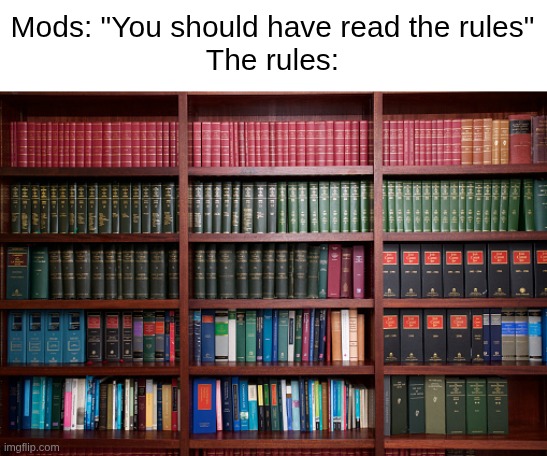
As someone who actually does read the rules for a bunch of places; they often have no relationship to what actually gets enforced.
This isn’t just a problem for social media communities. A bunch of business use boilerplate contracts and terms-of-service that again have no relation to how they actually operate.
I had a post about dishwashers (from the Technology Connections guy) removed from the Technology community because it wasn’t “on topic.” I’m sorry if I missed that dishwashers have been around since the Bronze Age.
Bronze is still technology. So are stone tools, and sticks when they’re used as tools.
Absolutely, and I really, really hate that. Admittedly I’m also autistic, so I probably take rules a bit more serious than many people. But still I am heavily confused by the concept that we live by laws every day which most of us never heard or read about. Especially in Germany, where I live, we have a lot of laws for everything, and 90% of them aren’t really enforced, but it still is theoretically expected of me to abide by them.
Just a strange concept overall.
There are a lot of cases where rules are a bit too strict, and it’s expected you might violate them where they don’t make sense - though if you do, you might be putting yourself at risk, and if something happens, the rule might protect anyone else involved.
But what pisses me off is that speed limits are consistently ignored. People might get mad at you for driving the speed limit. Either the limits are set stupidly low and need to be changed, or society needs to get its shit together and stop endangering people. Probably both.
There’s been experiments around changing speed limits. What they found is that people consistently speed by about a constant amount over the posted limit, so they keep the posted limit lower, and have all enforcement be at around 10mph over it.
Yay path dependence!
All rules and laws are always open to interpretation and arbitrary. I heard that in a presentation by a historian of jurisprudence. She said that many people think that national law is clear but international isn’t but neither is. All can be (and are) used by the rich and powerful. Not only do they lobby in the process of the creation of laws but also in their enforcement.