Looked into that, and I think with some assumptions you can figure out what it is.
One assumption is thats constitution exists in the vacuum, the other is that it’s the president that wants to turn state into dictatorship similarly as chancellor introduced Nazism in Germany. (This is the context Godel lived in)
IMO The issue seems to be with President being able to control senate and senate picking supreme court members.
Constitution itself gives President ability to replace absent senators - > Therefore president can replace any senator unfavorable to the change, and senate can pick favorable supreme court members. Once president controls supreme court, he can redefine any law into anything.
Constitution itself gives President ability to replace absent senators
What are you referring to? Governors replaced absent senators prior to the 17th amendment, after which it’s either the governor or a special election depending on the laws of that state.
“The President shall have Power to fill up all Vacancies that may happen during the Recess of the Senate, by granting Commissions which shall expire at the End of their next Session.”
I’m not native English speaker, but that very much sounds like president having a lot of power to replace absent senators while it’s not in session
OK, thanks for explaining, now I understand where you got things confused.
That’s not granting the president authority to appoint Senators. It’s granting the authority to (temporarily) appoint executive officers without needing Senate approval.
Things like Secretary of State, Attorney General, etc.
NOT Senators, though. The process to replace them is explicitly defined by the 17th amendment and is entirely up to the respective state.
I’m not a lawyer, and neither was Godel. I don’t know what sort of logic is being used for legal interpretation, but “all Vacancies” is as defined as it gets. For logician, if two procedures are defined without one explicitly excluding the other, both are legal.
The text immediately before that spells out what appointments the president can make:
he shall nominate, and by and with the Advice and Consent of the Senate, shall appoint Ambassadors, other public Ministers and Consuls, Judges of the supreme Court, and all other Officers of the United States, whose Appointments are not herein otherwise provided for, and which shall be established by Law: but the Congress may by Law vest the Appointment of such inferior Officers, as they think proper, in the President alone, in the Courts of Law, or in the Heads of Departments.
In context it’s clear that the vacancies being referred to are the vacancies of the positions the president has appointment power over, and that explicitly excludes senators since their method of appointment is already provided for by the Constitution.
You don’t have to be a lawyer to read the previous paragraph. It’s a section about appointing officers to executive agencies.
“[H]e shall nominate, and by and with the Advice and Consent of the Senate, shall appoint Ambassadors, other public Ministers and Consuls, Judges of the supreme Court, and all other Officers of the United States, whose Appointments are not herein otherwise provided for[…]” OK, but what if the Senate isn’t in session and we really need an Ambassador to Giratina? “Oh, ok, well in that case, The President shall have Power to fill up all Vacancies that may happen during the Recess of the Senate, by granting Commissions which shall expire at the End of their next Session.” They’re called recess appointments.
Even if that weren’t the case, the fact that this power is limited to “Officers […] whose Appointments are not herein otherwise provided for” means that senators aren’t included, because their appointment is provided for in Article 1, Section 3 and in the 17th Amendment.


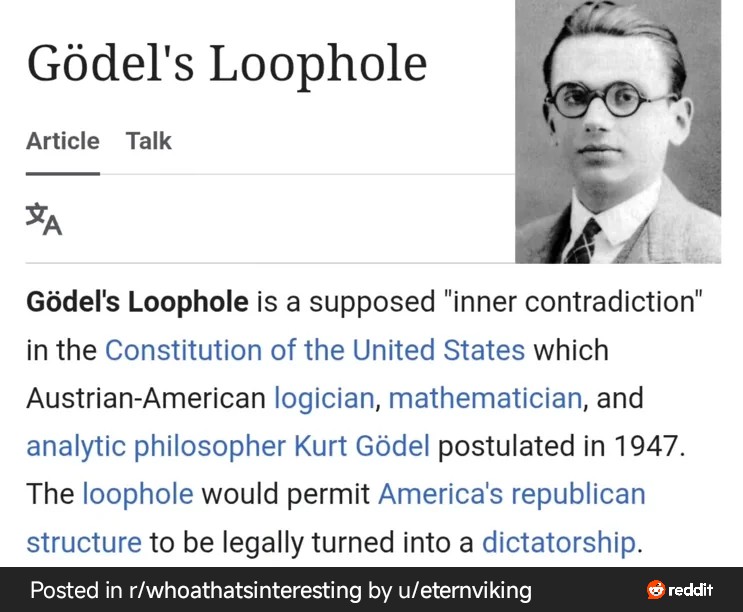
Looked into that, and I think with some assumptions you can figure out what it is.
One assumption is thats constitution exists in the vacuum, the other is that it’s the president that wants to turn state into dictatorship similarly as chancellor introduced Nazism in Germany. (This is the context Godel lived in)
IMO The issue seems to be with President being able to control senate and senate picking supreme court members.
Constitution itself gives President ability to replace absent senators - > Therefore president can replace any senator unfavorable to the change, and senate can pick favorable supreme court members. Once president controls supreme court, he can redefine any law into anything.
What are you referring to? Governors replaced absent senators prior to the 17th amendment, after which it’s either the governor or a special election depending on the laws of that state.
Article 2, section 2 of US constitution:
“The President shall have Power to fill up all Vacancies that may happen during the Recess of the Senate, by granting Commissions which shall expire at the End of their next Session.”
I’m not native English speaker, but that very much sounds like president having a lot of power to replace absent senators while it’s not in session
OK, thanks for explaining, now I understand where you got things confused.
That’s not granting the president authority to appoint Senators. It’s granting the authority to (temporarily) appoint executive officers without needing Senate approval.
Things like Secretary of State, Attorney General, etc.
NOT Senators, though. The process to replace them is explicitly defined by the 17th amendment and is entirely up to the respective state.
I’m not a lawyer, and neither was Godel. I don’t know what sort of logic is being used for legal interpretation, but “all Vacancies” is as defined as it gets. For logician, if two procedures are defined without one explicitly excluding the other, both are legal.
The text immediately before that spells out what appointments the president can make:
In context it’s clear that the vacancies being referred to are the vacancies of the positions the president has appointment power over, and that explicitly excludes senators since their method of appointment is already provided for by the Constitution.
You don’t have to be a lawyer to read the previous paragraph. It’s a section about appointing officers to executive agencies.
“[H]e shall nominate, and by and with the Advice and Consent of the Senate, shall appoint Ambassadors, other public Ministers and Consuls, Judges of the supreme Court, and all other Officers of the United States, whose Appointments are not herein otherwise provided for[…]” OK, but what if the Senate isn’t in session and we really need an Ambassador to Giratina? “Oh, ok, well in that case, The President shall have Power to fill up all Vacancies that may happen during the Recess of the Senate, by granting Commissions which shall expire at the End of their next Session.” They’re called recess appointments.
Even if that weren’t the case, the fact that this power is limited to “Officers […] whose Appointments are not herein otherwise provided for” means that senators aren’t included, because their appointment is provided for in Article 1, Section 3 and in the 17th Amendment.