The idea is a static body VTOL design that can hover stable in the air, and also go at high speeds very efficiently with wings. Could modify dimensions as needed, but general idea, I’m unsure if there’s a major design issue?
You must log in or register to comment.

Hey you stole the design I came up with when I was 7 years old. I’ll see you in court
I was 6 and my mum said I was the bestest engineer ever. I asked ChatGPT now and it confirmed I am absolutely correct. ChatGPT is never wrong.
I can’t believe NASA isn’t doing this
But planes are made of aluminium which is not ferromagnetic
So 99% of the time this thing is in level flight using one motor to carry 3 paperweights.
And no cargo. There’s not much room as drawn for anything else. The center of gravity with an engine up front would be fun. Maybe not impossible, the A310 couldn’t fly empty and was a pain to get the CG back enough.
You could theoretically run the front engine to help offset the weight
I have wondered about the prospect of an aircraft carrier that uses rotary-wing drones to launch and recover the fixed-wing aircraft. That’d give you a lot more flexibility as to the form factor of the ship, since you don’t need to do the deceleration or acceleration on the ship, let you launch and recover directly from stuff like submarines (and not like the I-400 class, which was really a seaplane carrier).
The US has been working on fixed-wing UAVs that are launched and recovered from a fixed-wing airborne aircraft carrier, Gremlins. If you can do that, I’d imagine that it’d also be possible to launch and recover them from a rotary-wing drone.
isn’t that what helicopters do?
edit: nevermind I see what you mean, 3 of the 4 rotors wouldn’t be doing anything
Without going into the aerodynamics, which plenty of others have gone into, the main problems I see are:
- The structural integrity of the wings is effectively kneecapped by those 2 rotors. There’s almost no material remaining where the wings meet the body and there’s a lot of force that needs to transfer through that area.
- Unless the center of gravity is within the triangle defined by the rotors, you’re going to have a really bad time trying to control that thing during vertical flight.
- Where would all the fuel and drivetrain for 4 props (which all take up significant space) live? There is almost certainly minimal room for any sort of cargo or payload.
- Why would you want a “thick unitary” frame (I’m assuming you mean unibody here)? We put thin skin with a supporting skeleton on aircraft to reduce the weight of the craft itself without sacrificing too much rigidity, which makes more weight available for fuel and/or cargo.
Is this a generated image? In addition to the font being the one that generated images tend to use, there’s some callouts here that also just don’t make sense: the double “pure one-piece static frame” and “thick, unitary body frame” callouts are, I think, saying the same thing in two unintuitive ways, and along with the “long clean wings” callout, none of them really have anything to do with the design concept here. Additionally, you’ve repeated the “maximum efficiency winged vtol configuration” and “cheapest minimalist one-piece construction” notes on the side, neither of which are necessarily true or provable from first principles based on the design- quite the opposite, if anything.
Great constructive feedback, thank you. Would you want to try to create a better design with this concept in mind? I think you have a clear understanding of what the idea is.
I got this one, I think it may be a bit better.

You don’t really gain anything from putting the props in the wings, and you lose a lot of wing strength.
Take a look at https://elroyair.com/ for a real-world vtol drone with fixed wings.
Yea but don’t the flat rotors cause drag? The point being, the rotor inside the wing is not causing drag.
oh they definitely cause some, but not nearly as much as the wing breaking because you’ve concentrated the stress into two small areas, or from having to add so many rotors inside the wings that they’re just one rotor next to another.
Take a look at a top down picture of one to get an idea of the swept rotor to wing area ratio. The swept rotor area is almost twice the wing area. If all those rotors were inside the wings, there wouldn’t be any wings left.
Did the ai that made this slop know it was supposed to fly?
I’m pretty sure I’ve seen small (i.e., handheld-sized) commercial UAVs that fly like this. But as others have pointed out, at any realistic size you start to run into a lot of problems:
- The VTOL rotors will create massive drag when they’re not in use. There’s a reason virtually every aircraft with embedded VTOL jets engineered ways to cover them up during level flight. This cascades into a whole bevy of complexity issues.
- When you’re not using them, you’re lugging around 3 out of your 4 rotors for no reason.
- You’re also sacrificing a lot of internal volume for your lift fans. This isn’t so much a problem in small UAVs, again, but it’s not great if you were hoping to use that capacity for fuel or cargo.
So yeah, like others said as well - now that we have tailsitter drones of moderate size, there’s not really a use for this layout.
Your wings would fall off. There is almost no material where they should be the strongest because there is a giant hole in it.
The center of gravity has to be forward of the side props or you’ll have a hard time balancing it. This means the mass of fuel/battery, engine and payload have to be around there.
You’ve seen how big the props are on toy drones, helicopters, or the V-22 compared to the rest of the thing? They need to be that big to provide enough lift.
Maybe, but what’s the advantage over tailsitters like this?
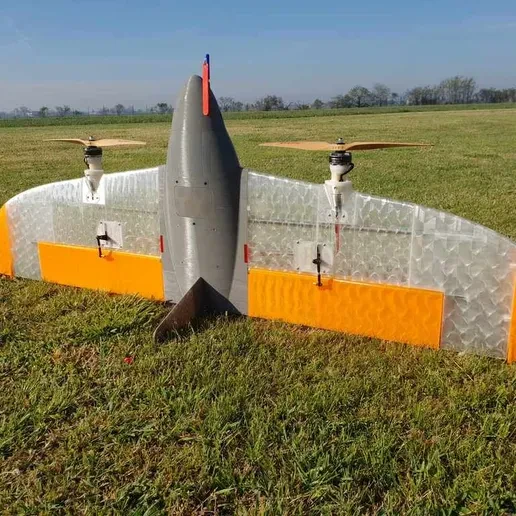
Or even the tilt-rotor quads/tris like the Flightory Stallion
The idea is for being able to hover while dropping cargo on a zip line, the design is inspired by the zipline uber eats.
Apparently the issue with this style is landing, for pilot ones anyway.
Rotor spin needs to even out or else it would spin all the time, that’s why drones have an even amount of rotors AFAIK.
I know fuck-all about aerodynamics and that kind of design stuff, but if you have the resources for it, would you be able to 3D print and wire a small-scale version of this as an RC flier? You could then test how it handles first-hand, and perhaps put it in a small wind tunnel (iirc Mythbusters had an episode where they made a cheap DIY one with a shop fan and plastic straws)
Maybe but prop planes have pretty short takeoffs and landings anyway, from the little I know.
The issue you have here is weight, how many engines do you need to power those 4 props.
Is this a post by an AI chat bot? The replies are odd.
Are you incapable of seeing my post history or just stupid?
Not my fault you sound like a bot. I don’t think your link proves much either. It doesnt really matter though.