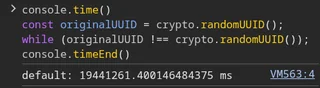

Only 5.4 hours before you hit a UUID collision. That’s insane
Against a apecific one too. Usually you’d check for duplicates against all previous uuids
That would indeed be way (quadratically) more likely but we don’t count the number of attempts but measure run time, and since comparisons (even with optimizations like insertion sort) take time, the speed difference between the two methods will be “just” a few orders of magnitude.
As long as you don’t run out of memory, you can actually insert and lookup in O(1) time for a known space of values (that we have). Therefore we do get the quadratic speedup, that when dealing with bits of keysize or entropy means cutting it in half.
Checking to get a specific uuid takes 128bit, so 2128 draws of a uuid. Putting all previous uuids into a table we expect a collision in 64bit, so 264. We also need about that much storage to contain the table, so some tens of exabytes.
Either this is faked for the meme or something is very very wrong.
I’m leaning heavily towards faked for the meme.
If you actually were trying to get collisions, you’d save all previously generated ids and check all of them for a match with the newest one.
Not only would this increase the chance of a collision (not enough that it should matter, but still), but it would more closely approximate a real use case - if you use UUIDs you’re not just in trouble if one specific id is duplicated, it’s usually a problem if any id is not unique.
But the presented snippet is simpler and shorter and is close enough to what a naive test might look like, so it’s well suited to getting the joke across.The only way I could imagine this not being fake is if it was achieved in a noncompliant Js implementation. Which seems highly unlikely given the screenshot looks like the Chrome console.
99.999999999999% chance the lava lamp inside your computer is broken.
(The difference from 100% might be my CPU’s floating point rounding error)
If it was random once, why shouldn’t it be on the 163rd repetition?
If this is reproducible without chicanery, I’m terrified
Without chicanery? Yes
Without luck? No
I think this is beyond luck. This is astronomical. It’s orders of magnitude beyond what is lucky for our entire civilization to have produced in its entire existence
is this cryptomining? /s
crypto - as in cryptography, not cryptocurrency - is just the library he’s using to generate the 128-bit random UUID. The snippet is interesting because he matched the original UUID in just over 5 hours. You’d expect to need more than 10^38 guesses to pick the same number again, which, even at 1 guess every microsecond, means something like 10^22 years.
I wanted to downvote you for failing to pick up on the sarcasm, but then you went and did all that math that I was too lazy to do and I ended up upvoting you instead. Damn you!
Sorry, I forgot to add the
/s.But thank you for the calculations, it’s actually interesting :) I was thinking about that myself, but didn’t bother to do the math.
I thought its reminiscent of cryptomining as it also consist of guessing an arbitrary number just for fun.
Internet sarcasm is hard, and lemmy has a very general audience :) I’m always happy when someone gives me an excuse to do the math I was already curious about - it’s often not worth it, for just my own curiosity, but even a sarcastic or disingenuous prompt reminds me that there’s other casually curious people out there.
I know how I’m heating my office this winter
Please tell this is fake. I want to be ignorant about this.
No problem. It’s fake. No need to look deeper.
I don’t understand
console.time()jots down the current time, if you do that twice and put stuff in the middle you get two times and the difference between them is how long that stuff took to doconsole.timeEnd()uses the last execution ofconsole.time()as the starting point to work out how long the stuff took to doconst originalUUID = crypto.randomUUID()generates a Universally Unique IDentifier, which can be thought of as a very large very random number, by use of a pseudorandom number generatorwhile(stuff)evaluates the stuff for truthiness (1 + 2 = 5 would be false, 50 < 200 would be true, ‘my username starts with the letter k’ would be true) it’s typically followed by a ‘block’ of code, that is lines beginning with{and ending with}, but we don’t see that here, which means we can readwhile(stuff)as “keep checking ifstuffis true in an endless loop, and only continue to the next line if one of the checks ends up beingfalse”the
stuffhere is creating another random UUID, and checking to see if it’s the same random number as the first one generated.functions like this are so incredibly random that chancing upon two executions creating the same number should be practically impossible. staggeringly impossible. If so this code should never complete, as that
whilecheck would be endless, never finding a matchthe image suggests that one such match was found in about 19 million milliseconds (a bit over 5 hours). this is probably faked, because the absurd unlikelihood of the same number being generated in so much as a single human lifetime, let alone a day, is laughable
the image is faked or something is terribly wrong with their pseudorandom number generator
But you can’t say that it’s fake or broken just because it’s unprobable, unless there’s supposed to be some additional safe guards to prevent the same random value from repeating within a certain distance from itself.
from a purely mathematical standpoint, yes
from a practical engineering standpoint, no, it’s impossible
I’m pedantic as they come, but pedantry has little use in an engineering discipline, software engineering included
like, if I take a cup of water and pour it into the Pacific Ocean strictly speaking I can say I “single-handed raised the water level of the ocean” and you’d be correct in the most unhelpful way
for the code in question if the PRNG is working as expected then for all meaningful purposes it can be considered impossible
edit oh also to fight pedantry with pedantry, technically even a check that would prevent duplicates might not prevent duplicates because you could argue there’s a non-zero chance a random cosmic ray flips just the right bit at just the right moment rendering even that pure chance. anything engineered (and not pure mathematical theory) has to draw the line of plausibility somewhere because we’re engineering inside of a chaotic reality. drawing the line to say that the image above is functionally impossible is just fine.
It just irked me that whenever something highly improbable happens it must be fake.
But I guess that’s just the proper way to view anything on social now-a-days.
We M-x butterflying now
Oh wow thank you
The function first generated a random UUID. This is a long string of random characters, used in many software systems to uniquely fingerprint things, transactions for example. In theory, you can have millions of seperate systems, each generating UUIDs all the time without ever having to worry about a collision (a collision is one or more systems generating the same UUID, therefore it being not unique anymore)
The second line then runs UUID generation again, trying to generate an identical UUID to the one it already made. Tis is absurd because even a dmsupercomputer trying to generate identical UUIDs would take longer than the lifespan of the universe.
The console line shows that a matching UUID was apparently found after some amount of time, which shouldn’t be possible, implying some fuckery with the random number generator.
This is probably due to sub standard random numbers. UUIDs are unique. If you manage to duplicate one your doing it badly.
I was able to reproduce this exactly.
brother you’re using the wrong thing. First of all you are using crypto that’s going to give you some memecoins that are obviously going to collide after 55 hours as what are you even doing not rugpulling the thing day 2?
Second of all, I am pretty sure you should use “RandomUUIDIToldYouSo” module for non-colliding hashes. We all know THAT thing gets its Noise from our parents’ instructions on doing a specific thing that keep changing arbitrarily every time you ask.