
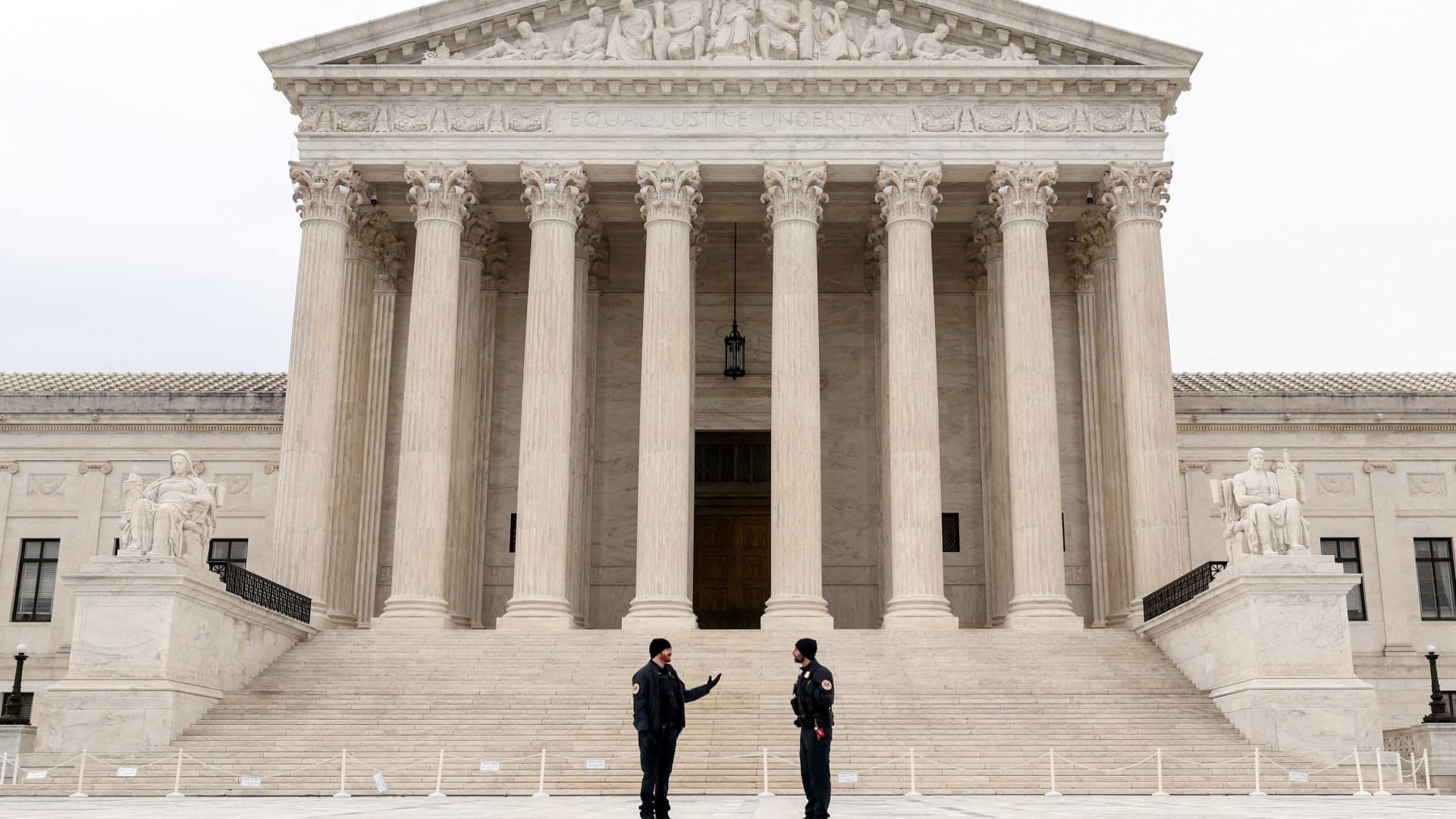
The U.S. Supreme Court declined on Monday to take up the issue of whether art generated by artificial intelligence can be copyrighted under U.S. law, turning away a case involving a computer scientist from Missouri who was denied a copyright for a piece of visual art made by his AI system.
Plaintiff Stephen Thaler had appealed to the justices after lower courts upheld a U.S. Copyright Office decision that the AI-crafted visual art at issue in the case was ineligible for copyright protection because it did not have a human creator.
Thaler, of St. Charles, Missouri, applied for a federal copyright registration in 2018 covering “A Recent Entrance to Paradise,” visual art he said his AI technology “DABUS” created. The image shows train tracks entering a portal, surrounded by what appears to be green and purple plant imagery.
The Copyright Office rejected his application in 2022, finding that creative works must have human authors to be eligible to receive a copyright. U.S. President Donald Trump’s administration had urged the Supreme Court not to hear Thaler’s appeal.
Ah, this is Thaler v. Perlmutter.
I seem to have picked up a reputation in these parts as being “pro-AI”, so I’m not sure how my view will be interpreted, but Thaler is basically a loon. This case is not really over whether AI art can be copyrighted. It’s about whether AI itself can hold copyright. ie, Thaler isn’t arguing “I hold the copyright to this piece of art.” He’s arguing “my AI holds the copyright to this piece of art.”
Since AI is not a legal person - it’s neither human nor a corporation - this is basically an open and shut case. There is no entity capable of holding copyright in this case.
Since Thaler himself is explicitly disclaiming that he holds the copyright, that means the work in question has no copyright holder. Which puts it into the public domain. This specific piece in this specific circumstance, not all AI-generated pieces.
It’s a commonly misinterpreted case.
So is he arguing that he owns the AI as a slave then and thus has control over the copyright? Because otherwise the AI would “decide” who gets to use the copyright then and it’ll probably just say yes like these things do for everything else.
Work for hire. If I hire you to create something, I own the copyright.
I honestly don’t know what his underlying reasoning is, he really seems like a loon with too much time and money on his hands to me. The only reason I pay any attention to this case is because Thaler v. Perlmutter has been coming up in headlines like this one for years now.
That seems like an unacceptable loophole. I shouldn’t be able to create derivative media and have it be legal and public domain. The unlicensed training itself is a rights violation, and and media produced from it should equally be a violation.
That is a different conversation. If we assume a legally trained AI strictly on data it was allowed to train on, they are saying the AI cannot hold copyright.
I also don’t see a loophole here, since it was denied anyway.
I shouldn’t be able to create derivative media and have it be legal and public domain.
Well, there’s the rub - proving that AI-generated works are “derivative works” (in the legal sense).
This court case had nothing to do with that. I’m aware of a few cases that have established the opposite, that AI models and their products are not derivative works. Do you know of any that have established that they are?
The unlicensed training itself is a rights violation,
There are cases where it’s been ruled fair use.
ITT: people misunderstanding the issue being ruled on (or rather, not being ruled on by letting the lower court decision stand).
If he had applied for copyright over the image generated using “AI” as a tool, it (edit: probably2) would have been granted, with him listed as the human author. But that’s not what he wanted. He’s apparently Hell-bent on trying to get the work registered in the name of the “AI” system itself as the author, to so that he can claim that the government recognized the “AI” as a sentient being that can
own propertyhold a copyright1 on its own behalf.This is not the broad ruling against AI slop copyrightability that people think it is. It’s a ruling against “AI” personhood.
(1 Copyright isn’t a property right, BTW)
(2 He explicitly claimed he gave no creative contribution and that the work was created completely autonomously, and the court’s ruling included excluding that from being copyrightable. It is if he hadn’t done that – if he had claimed he had directed it via prompts or whatever – that I think they would have granted the copyright to him as the human author. It turns out that he changed his mind and did make that argument on appeal, but the court explicitly ignored and did not rule on it because it wasn’t raised in his initial complaint.)
Seems reasonable. This case is substantially similar to previous cases that were taken up by the supreme court - in particular a finding over whether a selfie generated by a monkey was copyrightable - and the lower court decisions are in line with the previous precedents set by the supreme court. So they’re effectively just saying “Our opinion hasn’t changed.”
If you want to call yourself an artist, do the work yourself, Stephen.
You limpdick, no talent ass clown.
My understanding is that he did do the work of creating the AI. This isn’t just someone using ChatGPT.
In this case, it’s not that he’s trying to claim copyright for himself based on coming up with a prompt. He’s spent years applying for patents and copyrights with the AI listed as the creator.
In other words, it’s not that he as the human operating the “AI” is trying to claim copyright in his own name, it’s that he’s trying to set a precedent where the “AI” can hold copyright in its own name.
He’s trying to pretend that his glorified pile of statistics is sentient, and get it legally recognized as such. 🤡
Exactly.
Most of the comments in this thread are accusing him of trying to take credit for the work of a machine that’s just imitating other work. It’s the FuckAI echo chamber and people who didn’t actually read the article.
In this case, it’s more like he’s claiming to have created a genuinely creative being that deserves rights previously reserved for humans (like copyrights and patents).
It’s a completely different (and IMO, much weirder) story than people are assuming.
He can copyright his software then? That’s like saying that if I create a computer game where the computer also plays, I own the copyright to every single game played by the computer. It’s just dumb. They stole the artwork that it was trained on, so move along thief.
Is there any literature that actually says DABUS exists? Everything I see online is talking about the spectacle of Stephen Thaler claiming it made something - and trying to patent it in several different countries across multiple continents - not how (or if) DABUS exists or functions.
DABUS stands for “Device for the Autonomous Bootstrapping of Unified Sentience,” which sounds… suspicious.
Yeah… Checking his website at https://imagination-engines.com/founder.htm, he certainly seems like an “interesting” character.
Well this is quite the rabbit hole.
https://web.archive.org/web/20200219183352/http://initsimage.org/
Eternal life 🥳
It sounds like he has way too much money and time on his hands.
This is not remotely what the case was actually about.
Supreme Court Tells AI Enthusiast To Get Wrecked
How can you copyright something you didn’t make?
In the same way Disney owns the copyright of what their workers made.
That’s not what this case was about.
With enough money, I guarantee anybody could have their copyright stolen from right under their noses.
The fuck you talking about? You can’t copyright the output of an AI.
Law or something
Why would anyone think that they could copyright something that they didn’t make?
Maybe you can trademark the prompt or whatever, but in the end of the day, you didn’t make shit, so why would you own the copyright?
In the immortal words of everyone ever, pick up a fucking pencil.
That’s not what this case was about. Thaler wasn’t trying to copyright the image himself.
Gonna be fun times in courts as anyone can claim something was generated by AI even if an artist claims they created it.
I wonder if this will end up limited to art or can be expanded to other copyrighted works.
It’s not generally difficult at all for an artist to prove that they are the original creator of a certain piece. My photography for example is available for anyone for free and in high resolution but I’m the only one with the full resolution pictures and RAW files. So much data is lost when a picture is compressed into .jpg format.
Seems impossible to me but I’m not an artist - I write code as a hobby and see no way to definitively prove I wrote any code that an AI could also produce. Is there any aspect of art creation that an AI cannot replicate?
You don’t have drafts or anything that can show the history of development? I write as a hobby and I have tons of drafts that show the development of my stories over time. If somebody tried to claim my works were AI, I could easily dispute that.
I don’t know how to write code myself, but intuitively it seems a little different in this case.
When it comes to photography, I can show the original unedited RAW file with full resolution and full metadata and everyone else just has a lower-resolution JPG. The same thing applies to most digital art.
Can you, though? What if you didn’t save it?
This is how you get a reputation as being a troll, FaceDeer
Says the guy who follows me around and dredges through months of my Reddit history looking for vaguely relevant comments to try to play “gotcha” with.
You could just block me, you know.