

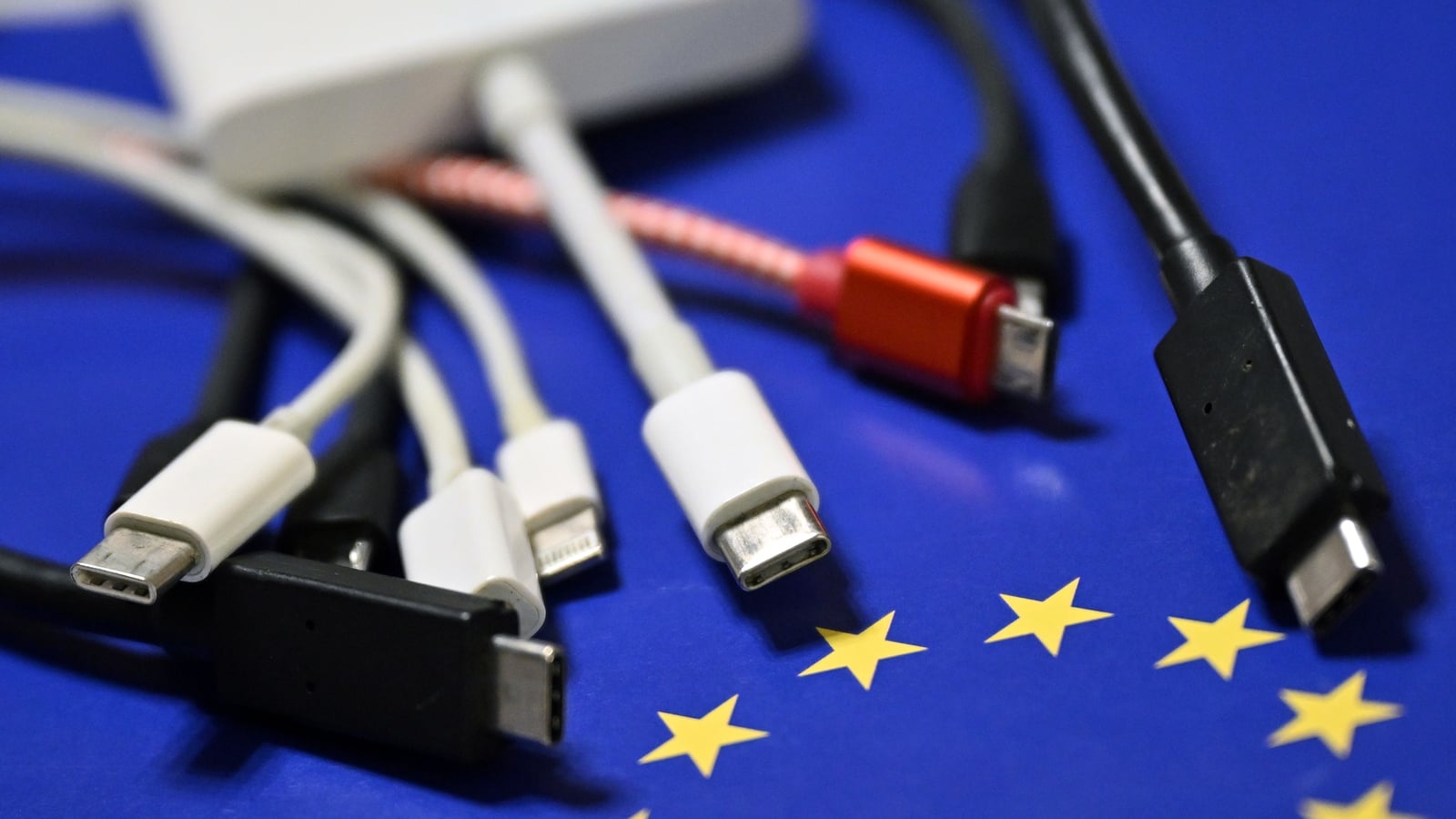
EU rules on common chargers apply to laptops from today. It means that all new laptops sold in the European Union must now support USB-C charging.
In December 2024, the rules came into force for mobile phones, tablets, digital cameras, headphones, videogame consoles, and portable speakers.
Laptop manufacturers were given a longer lead in time to allow for redesign and transition to the common charging system.
Glad you did, because I was gonna make a comment about how high end gaming laptops are now illegal in the EU.
Not sure there’s a 330w USB C going around I could use.
The limit should really be 240W, because that’s what the USB-C PD 3.1 spec goes up to.
Edit: Per reply, the regulation is designed with 240W accounted for, and updatable in case of further improvements to the standard.
It is 240 W actually. Seems Techpowerup was wrong. See my first comment: https://discuss.tchncs.de/post/59511400/25528592
When you make minimum requirements, you dont go for max. All laptops shouldnt be able to take 240W.
Laptops can be rated for whichever power level the manufacturer prefers; USB-C PD is used between the power supply and device to negotiate the maximum power level allowed for by both, so a consumer that purchases a 100W or 240W cable and power supply could still use them with a lower-rated device.
A 60W USB-C laptop can therefore stay at 60W without issue, but if a 240W laptop is produced, it should also be made to use USB-C under such a regulation.
Fair point. But it will still be overkill to require 240W for a device that will never take it.
I know it will regulate output. But requirements should make sense.
sounds like they do
https://discuss.tchncs.de/comment/25528592
Nope, still perfectly legal. Proprietary charging ports are allowed but have to be accompanied by a USB PD port that supports the same wattage (or 240 W if the device needs more than that).
So basically the law says “devices must support USB PD”, not “devices must only support USB PD”.
Mines not a barrel either, big ol rectangle
Can’t the provider just make two charging ports?
They can.
USB-C goes up to 240 W now and the law has been amended to acknowledge the new USB PD spec. Devices are also allowed to have proprietary charging ports but must include a USB-C port capable of showing the full power draw of the device (or 240 W of they need more than that).
So a big gaming laptop might have a USB PD-capable port that supports 240 W and a barrel jack that supports 350 W.
So yeah, basically what I supposed. Gaming laptops are bulky so there defo no shortage of space
The limit is apparently 100w, so they would need 4 charging ports. But also, who is gonna want to plug in their laptop to the wall twice, even if it’s 2x240w?
USB-C can take 240W. The law just says all laptops under 100W need to use USB-C, not that others are not allowed.
How big a niche is that - because when I think high end gaming a laptop has all sorts of trade offs to make anyway.
They sell more than you’d expect, tons of companies do them.
The trade offs are high price and low battery, comparitavely.
On the plus side, I have a easily movable PC that will run new games at ultra settings and it takes about 20s to fully pack up.
Luggables are quite common for gamers who travel a lot. I can’t take a tower into hotels easily, but most of my free gaming time is on the road. I know quite a few people with portable gaming systems.
My current laptop is rocking a 4080, with a water cooling loop. It has to fall back to internal graphics when on battery. The batteries just can’t provide the current required.
The majority of my gaming is on the road too but I’ve found the Steam Deck hits that niche for me. I carry a thin Chromebook for work related things. Admittedly you don’t need as powerful a GPU for a small 720p display.
I’ve also got a steam deck. Unfortunately it just doesn’t cut it for games like satisfactory or factorio.
Couldn’t they just make two charging ports? A generic 100W usb and a proprietary one?