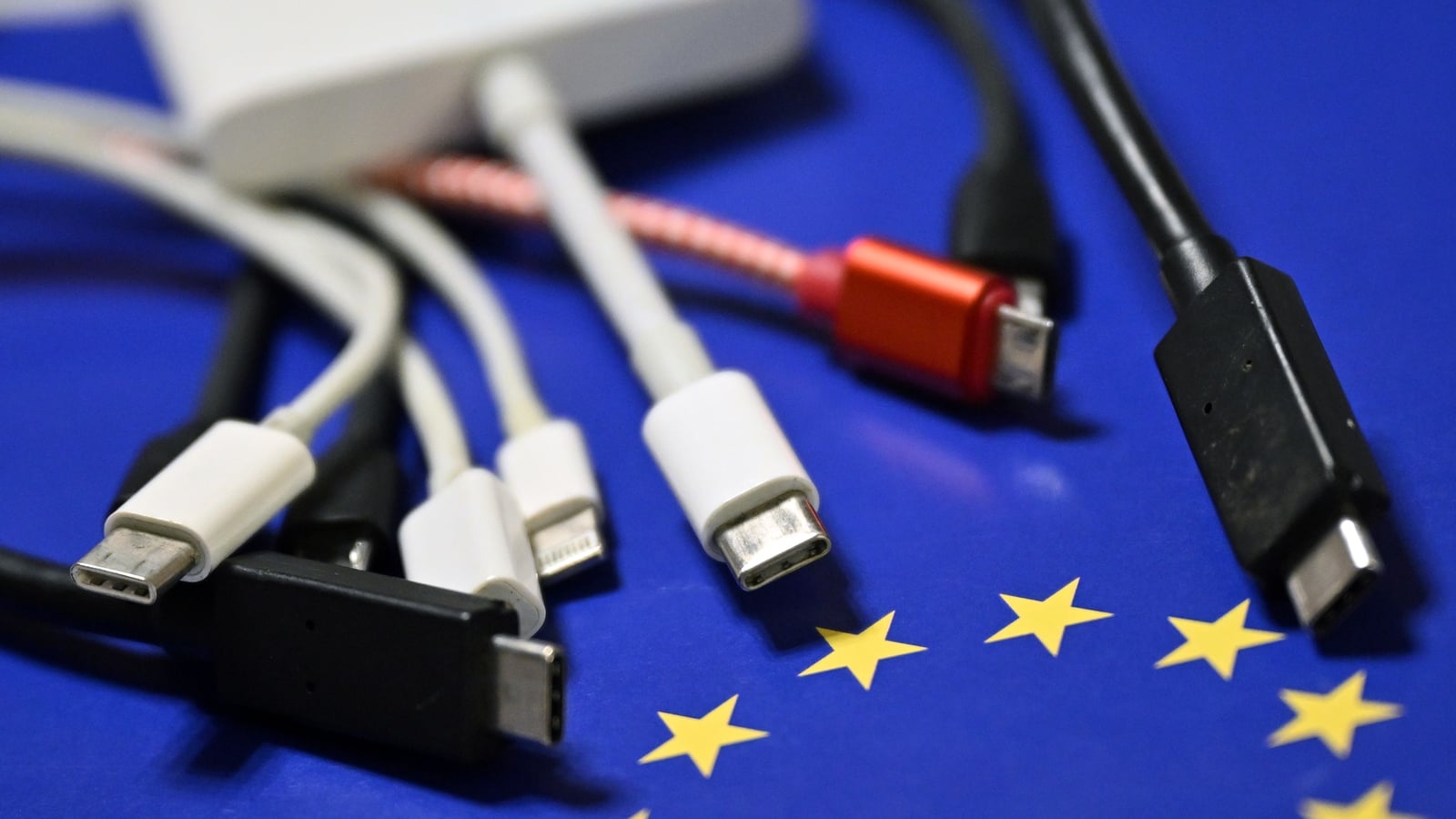
EU rules on common chargers apply to laptops from today. It means that all new laptops sold in the European Union must now support USB-C charging.
In December 2024, the rules came into force for mobile phones, tablets, digital cameras, headphones, videogame consoles, and portable speakers.
Laptop manufacturers were given a longer lead in time to allow for redesign and transition to the common charging system.
I just love the EU. Not perfect of course, but this kind of stuff is great.
Nothing is perfect, but the EU is by far the best government entity for consumers right now.
They have an excellent control of their market.
The article doesn’t mention the requirement’s 100W limit.
Edit: Per reply, the regulation is designed with 240W accounted for, and updatable in case of further improvements to the standard.
Glad you did, because I was gonna make a comment about how high end gaming laptops are now illegal in the EU.
Not sure there’s a 330w USB C going around I could use.
The limit should really be 240W, because that’s what the USB-C PD 3.1 spec goes up to.
Edit: Per reply, the regulation is designed with 240W accounted for, and updatable in case of further improvements to the standard.
It is 240 W actually. Seems Techpowerup was wrong. See my first comment: https://discuss.tchncs.de/post/59511400/25528592
When you make minimum requirements, you dont go for max. All laptops shouldnt be able to take 240W.
Laptops can be rated for whichever power level the manufacturer prefers; USB-C PD is used between the power supply and device to negotiate the maximum power level allowed for by both, so a consumer that purchases a 100W or 240W cable and power supply could still use them with a lower-rated device.
A 60W USB-C laptop can therefore stay at 60W without issue, but if a 240W laptop is produced, it should also be made to use USB-C under such a regulation.
Fair point. But it will still be overkill to require 240W for a device that will never take it.
I know it will regulate output. But requirements should make sense.
sounds like they do
Nope, still perfectly legal. Proprietary charging ports are allowed but have to be accompanied by a USB PD port that supports the same wattage (or 240 W if the device needs more than that).
So basically the law says “devices must support USB PD”, not “devices must only support USB PD”.
Gaming laptops can continue to use the typical barrel power connector on models that exceed 100 W of power
Mines not a barrel either, big ol rectangle
Laptops above 100W don’t need a USBC charging port.
Can’t the provider just make two charging ports?
They can.
USB-C goes up to 240 W now and the law has been amended to acknowledge the new USB PD spec. Devices are also allowed to have proprietary charging ports but must include a USB-C port capable of showing the full power draw of the device (or 240 W of they need more than that).
So a big gaming laptop might have a USB PD-capable port that supports 240 W and a barrel jack that supports 350 W.
So yeah, basically what I supposed. Gaming laptops are bulky so there defo no shortage of space
The limit is apparently 100w, so they would need 4 charging ports. But also, who is gonna want to plug in their laptop to the wall twice, even if it’s 2x240w?
USB-C can take 240W. The law just says all laptops under 100W need to use USB-C, not that others are not allowed.
How big a niche is that - because when I think high end gaming a laptop has all sorts of trade offs to make anyway.
They sell more than you’d expect, tons of companies do them.
The trade offs are high price and low battery, comparitavely.
On the plus side, I have a easily movable PC that will run new games at ultra settings and it takes about 20s to fully pack up.
Luggables are quite common for gamers who travel a lot. I can’t take a tower into hotels easily, but most of my free gaming time is on the road. I know quite a few people with portable gaming systems.
My current laptop is rocking a 4080, with a water cooling loop. It has to fall back to internal graphics when on battery. The batteries just can’t provide the current required.
The majority of my gaming is on the road too but I’ve found the Steam Deck hits that niche for me. I carry a thin Chromebook for work related things. Admittedly you don’t need as powerful a GPU for a small 720p display.
I’ve also got a steam deck. Unfortunately it just doesn’t cut it for games like satisfactory or factorio.
Couldn’t they just make two charging ports? A generic 100W usb and a proprietary one?
Putting “Universal” back in “USB”
I bet it’s not available on Jupiter.
and it’ll take a few million years for Andromeda to get the news
Let’s change that.
Send Elon.
He said “Jupiter”, not “the Sun”.
The source of law here is Directive 2022/2380 (which amends Directive 2014/53), in Article 2 a grace period until 2026-04-28 is defined for the category of laptops. This has now expired, which explains the renewed wave of articles being published.
The directive itself is not that interesting to read, as a lot of it is just empowering the Commission to make a decision on the specifics. The result is in the Commission Delegated Regulation 2023/1717. Although it seems to me like something is missing. I can’t find more though.
A very interesting Q&A from their Commission Notice – Guidance document:
- Are laptops and other radio equipment that require more than 240 W of charging power exempted from the ‘common charger’ rules?
No. They are not exempted. Radio equipment which is subject to the ‘common charger’ rules must incorporate the harmonised charging solution.
The Commission has updated (in Commission Delegated Regulation (EU) 2023/1717), the references to the standards cited in Annex Ia to the latest version of the European standards. Therefore, due to the amendments introduced by this delegated regulation, radio equipment subject to the ‘common charger’ rules must incorporate the harmonised charging solution up to their maximum charging power or up to 240W if their maximum charging power is above 240W (as opposed to 100W in the previous versions of the standards concerned).
The Commission will continue to update the technical specifications set out in Annex Ia, in order to reflect scientific and technological progress or market developments provided that such developments meet the objectives of the common charging solution.
But then also
- Are proprietary charging receptacles allowed in addition to a USB-C receptacle?
Yes. The RED only requires radio equipment subject to the ‘common charger’ rules to be equipped with the USB-C receptacle. The use of other receptacles is therefore not prohibited as long as the covered radio equipment is also equipped with a harmonised charging (USB-C) receptacle.
That means those hefty laptops going up to 350 W or whatever, now need to accept 240 W over USB PD, but they may still include additional proprietary charging solutions that are rated higher.
Also I don’t think the 100 W limit that some outlets report is actually in force since 2023/1717 has replaced the references to ‘EN IEC 62680-1-3:2021’ by those to ‘EN IEC 62680-1-3:2022’
Reading on, yes they make that explicit further down:
- Is a radio equipment allowed to charge above 240 W when using an additional charging protocol?
Yes. If the radio equipment proprietary charging solution requires more than 240 W (e.g. 300 W), the concerned radio equipment must also support USB PD up to 240W.
The Commission has updated, via Commission Delegated Regulation (EU) 2023/1717, the references to the standards cited in Annex Ia to the latest version of the European standards. The updated version of the standards will apply as of the date of applicability of the relevant rules introduced to the RED by the Common Charger Directive, i.e. for handheld mobile phones, tablets, digital cameras, headphones, headsets, handheld videogame consoles, portable speakers, e-readers, keyboards, mice, portable navigation systems and earbuds, as of 28 December 2024 and, for laptops, as of 28 April 2026. This means that as from those dates a radio equipment, if it listed in Annex Ia and is capable to be recharged by means of wired charging at power above 240 W, must incorporate the harmonised charging solution up to 240 W.
The Commission will continue to update the technical specifications set out in Annex Ia, in order to reflect scientific and technological progress or market developments provided that they meet the objectives of the common charging solution.
Oh no the innovation will suffer! How are the laptop makers going to screw the consumers now?
Now make them put a port on each side of the laptop!
What if the ports are recessed and you have built in dongles you can swap to change the port type on either slot?
Oh wait, framework did it :)
Though, to be fair, Framework laptops can’t charge from all of their ports. The 16 can charge from one port each per side; not sure about the 13 and 12.
Well, I have a 16 and it can be charged on 4 out of the 6 ports. It is true though that not all ports are equal. Some supporting display, others not, some consuming more power when a USB-A is plugged into them etc.
The diagram is here: https://knowledgebase.frame.work/expansion-card-slot-functionality-on-framework-laptop-16-amd-ryzen-7040-series-rkUjGm7cn
The 13 (amd) can charge from either side not sure if the ports closer to the keyboard also charge at the same speed
Edit: Apparently they do. (negotiating 3A PD on a first come first serve basis)
So the shape of the plug is the same for all devices regardless of the spec… doesn’t it just make things more confusing for non techies? I can already see people saying their new laptop is broken because their 5v 0.67A power brick won’t charge it, or buying a USB-c charger just to find out it doesn’t work. A lot of aftermarket chargers claim to support up to 120W etc. Except they mean 120W is a sum of all ports for a 6 port charger so really it’s only 20W. For techies it can get annoying too if you like to play with hardware. You can just feed appropriate voltage DC over those barrel connectors, for example from a car battery with a buck converter or AA/18650 in series and it will work while usb-c charging needs to be negotiated.
A lot of aftermarket chargers claim to support up to 120W etc.
That is called deceptive marketing.
If you plug in a weak charger or an inadequate cable you will get a message on the screen saying as much. Also, the new law doesn’t prevent manufacturers shipping proprietary chargers alongside USB-C.
Yeah right, my laptop supports usb c charging, but it came with the usual power brick that I use if I need a faster charge.
I guess all those tech enthusiasts will have to buy a cheap bms board that can control those batteries and negotiate the charging. Their brave seven bucks sacrifice in that regard will have to suffice.
There has been a lot of marketing done towards non techies regarding charge speeds, so most common people do know about it. Plus most people will also just buy the one the companies will suggest or bundle.
A little side thing that’s also important is that in Europe the salespeople aren’t simply trying to get you to buy their product with the highest markup, which means you’ll get people that will actually look up your laptop and sell you a correct charger.
Aftermarket crap is a thing though, but from what I’ve seen most people will understand it’s because they bought cheap Chinese stuff.
Nope.
Apple in shambles
Apple was one of the co developers of USB C.
Anything but