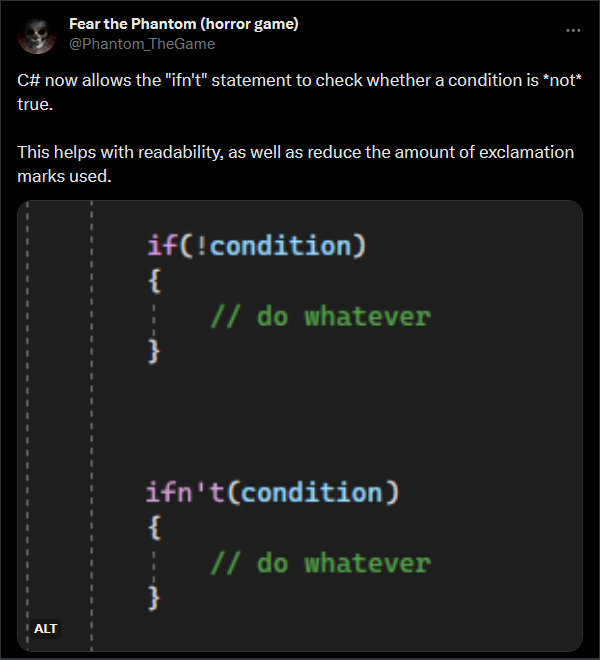
JPDev@programming.dev to Programmer Humor@programming.dev · 2 years agoifn'tprogramming.devimagemessage-square106fedilinkarrow-up1631arrow-down111
arrow-up1620arrow-down1imageifn'tprogramming.devJPDev@programming.dev to Programmer Humor@programming.dev · 2 years agomessage-square106fedilink
minus-squareTrailblazing Braille Taser@lemmy.dbzer0.comlinkfedilinkarrow-up161arrow-down1·2 years agoI propose a new, more threatening kind of control flow. do { /* something */ } or else { /* you don't want to find out */ }
minus-squaregex@lemmy.worldlinkfedilinkarrow-up43·2 years agoSome C++ style guides suggest the following naming convention for functions that crash on any error OpenFileOrDie()
minus-squarexmunk@sh.itjust.workslinkfedilinkarrow-up21·2 years agoPHP has the always wonderful (and perfectly functional) syntax of logUserIn() or die();
minus-squareevatronic@lemm.eelinkfedilinkEnglisharrow-up2·2 years agoWhere do you think PHP stole it from?
minus-squareKissaki@programming.devlinkfedilinkEnglisharrow-up6·2 years agoPersonally, I like to call catched exception variables up, so for a rethrow I can throw up;.
minus-squareTwilightKiddy@programming.devlinkfedilinkarrow-up1·2 years agoExcept rethrowing an exception in C# is just throw;, anything else is a crime against the person who reads your stacktraces.
minus-squareOpenStars@startrek.websitelinkfedilinkEnglisharrow-up4·2 years agoIt’s funnier when you try to SysCallAndDie() :-P (that’s a real thing in perl btw - I guess that function didn’t get the memo)
minus-squareVorthas@programming.devlinkfedilinkarrow-up3·2 years agoOne of the modules in a project I’m working on is called VulkanOrDie which always makes me crack up when I see it in the compilation messages.
minus-squareyum13241@lemm.eelinkfedilinkarrow-up1·2 years agoNow what about GZDoom’s GoAwayAndDie();?
minus-squareMesa@programming.devlinkfedilinkarrow-up8·2 years agoThe better try-catch. More intuitive if you ask me.
minus-squarejadelord@discuss.tchncs.delinkfedilinkarrow-up5·2 years agoIt exists, kind of. Python has this construct for item in iterable: ... else: ... which always puzzles me, since it depends on a break statement execution. I always have to look it up when the else block is executed.
minus-squareOpenStars@startrek.websitelinkfedilinkEnglisharrow-up5arrow-down1·2 years agoYou just made me a offer I can’t refuse. I go now to sleep with the fishes…
minus-squarerothaine@beehaw.orglinkfedilinkEnglisharrow-up4·2 years agodo { /* something */ } do hast { /* something */ }
minus-squareTrailblazing Braille Taser@lemmy.dbzer0.comlinkfedilinkarrow-up6·2 years agodo { /* something */ } do hast { /* something */ } do hast mich { /* something */ }


I propose a new, more threatening kind of control flow.
do { /* something */ } or else { /* you don't want to find out */ }Some C++ style guides suggest the following naming convention for functions that crash on any error
OpenFileOrDie()PHP has the always wonderful (and perfectly functional) syntax of
logUserIn() or die();Or Perl
Where do you think PHP stole it from?
Bash?
Personally, I like to call catched exception variables
up, so for a rethrow I canthrow up;.Except rethrowing an exception in C# is just
throw;, anything else is a crime against the person who reads your stacktraces.It’s funnier when you try to SysCallAndDie() :-P
(that’s a real thing in perl btw - I guess that function didn’t get the memo)
One of the modules in a project I’m working on is called
VulkanOrDiewhich always makes me crack up when I see it in the compilation messages.Now what about GZDoom’s
GoAwayAndDie();?It_would_be_a_shame_if(condition)
The better try-catch. More intuitive if you ask me.
It exists, kind of. Python has this construct
for item in iterable:
    ...
else:
     ...
which always puzzles me, since it depends on a break statement execution. I always have to look it up when the else block is executed.
You just made me a offer I can’t refuse. I go now to sleep with the fishes…
do { /* something */ } do hast { /* something */ }do { /* something */ } do hast { /* something */ } do hast mich { /* something */ }