
You must log in or register to comment.
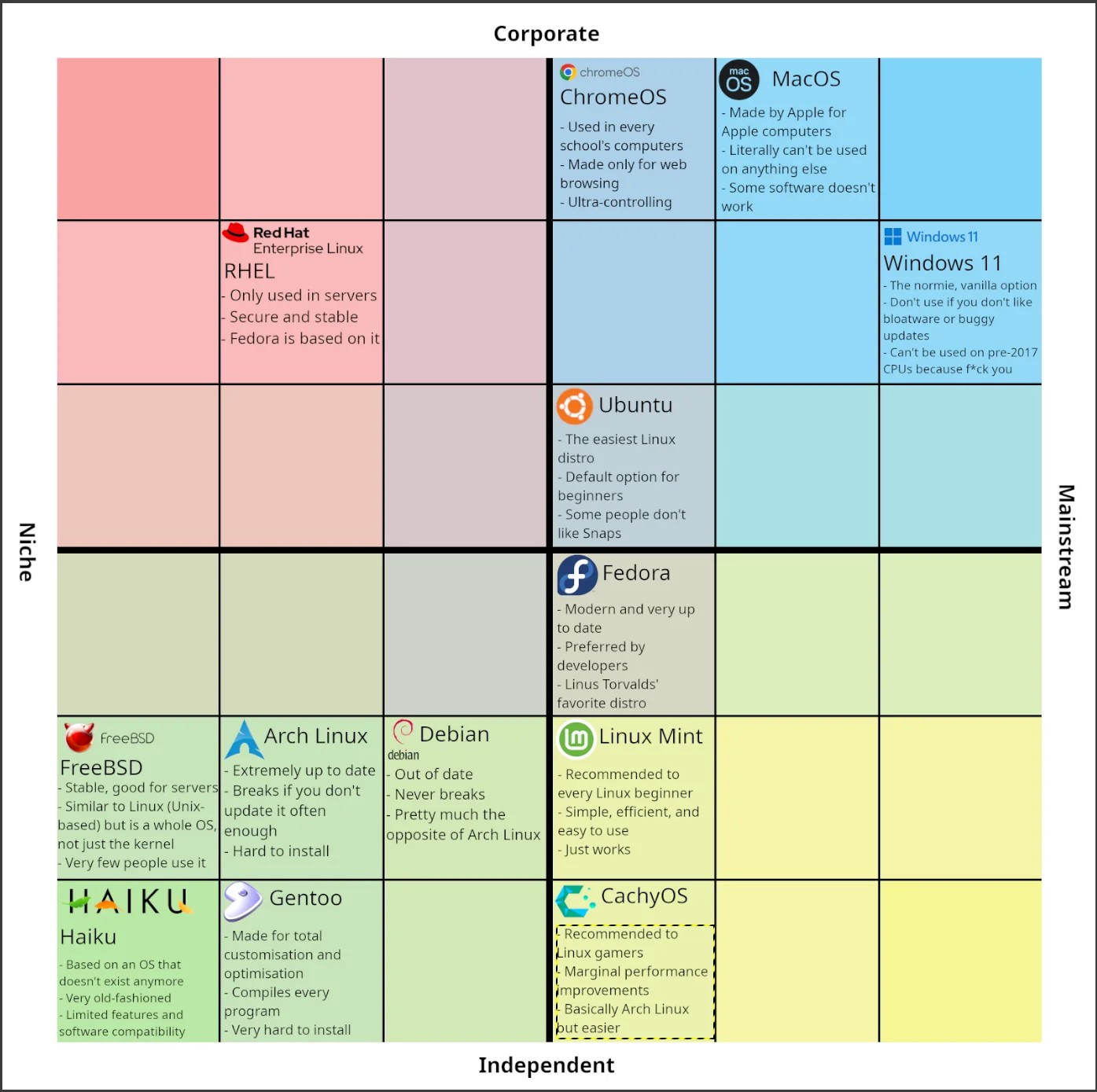
Some people don’t like snaps
“Some people like snaps” would have been closer to the truth, but it would still be an exaggeration of their numbers.
I bet Mark Shuttleworth likes Snaps.
How is Windows less corporate than MacOS or ChromeOS?
LOL at Windows being marked as less corporate than MacOS. They should absolutely be at least tied.
Literal megacorporations have run purely on Windows since the 90s and it’s not S-tier corporate? lol
Windows is not at the top of corporate possibly because it can be installed on non-homologated PCs.
But on the other hand, all the reasons that people hate corporate OSes apply much more to Microsoft than Apple. Microsoft is the company that puts ads in their OS and is built entirely out of proprietary tech, and has been more vocal about shoehorning AI into everything.
That’s a poor qualifier. Most corporations do not deploy MacOS to their employees. Windows belongs in the top right, if not a full line by itself for Corporate.
How is Debian More niche than cachy?
Red Hat is based on Fedora, not the other way around.
From your own link, Fedora:
…is now the upstream source for CentOS Stream and Red Hat Enterprise Linux.
So yes, I’m pretty sure.
Windows is more corporate than that Ubuntu is more corporate and mainstream than that.
I don’t think “upstream provider for newer packages” is the same as “based on”. Fedora was developed from Red Hat, the image is correct in that sense. You can quote that part of the link but I specifically pointed to " It was originally developed in 2003 as a continuation of the Red Hat Linux project." so based on Red Hat.
Read the paragraph again. This time with your eyes.
It was originally developed in 2003 as a continuation of the Red Hat Linux project… It is now the upstream source for CentOS Stream and Red Hat Enterprise Linux.
Did you notice how it says “Red Hat Linux Project” and then goes on to say “Red Hat Enterprise Linux”?
This is because RHL != RHEL.
From the Hyperlink on the Wikipedia page for RHL:
Red Hat Linux was a widely used commercial open-source Linux distribution created by Red Hat until its discontinuation in 2004.
OP is correct. You are mistaken for thinking RHL was RHEL. It is not.
You are right, my mistake for mixing the two.
Yup, in fact the base of RHEL 10 and CentOS Stream 10 is Fedora 41. For RHEL 9 it was Fedora 34 if I remember correctly.
Okay buddy
Arch isn’t hard to install (anymore). It takes 5 minutes with archinstall.
btw
Helps if you know that command/setup thing/whatever you wanna call it. Otherwise, for someone who doesn’t know about it, the process can be pretty painful. Even with the wiki’s install instructions I have not been able to install arch the few times I tried in a VM over the past few months.
implying that Arch is niche at this point
You forgot SuSE, as usual.
SuSE can hang out with New Zealand and Gen X
I’ve worked on suse as part of Unitedlinux.
No, I’d say it’s not forgotten. Just repressed.
Arch Linux breaks if you don’t update it often enough
pacman -S archlinux-keyringIt’s really that easy
It’s more like “Arch Linux breaks if you don’t update for too long, then try to naively update without knowing what you’re doing and without checking the arch news for breaking changes”. Which is more breakage during updates than stable distros, but absolutely manageable.
I’d put Haiku on the extreme top left corner (or in one of the two rows below that first column) since it’s based on BeOS - it’s a corporate OS wether it exits or not and it intends to replicate said corporate OS. In its place I’d put either TempleOS or Plan9.
TempleOS. Oh jeez it’s been awhile since I’ve heard that.
If you ask me, the top left corner belongs to IBM i.
Replace Haiku with TempleOS
EDIT: Also, put Windows in the top right corner to avoid the “is Microslop or Apple more corporate” discussion.
I had the same reaction to the Microslop vs Apple corporateness at first. But they kinda have a point as in that Apple controls the entire stack from hardware to os, while windows is just the os
while windows is just the os
They so very want to be just like apple in that reguard.
but they aren’t yet
Fedora isn’t based ln RHEL, it was before, but now it’s in fact the opposite. As far as I know, RHEL 10 is based on CentOS Stream 10, which in turn is based on Fedora 41.
That’s correct. The community threw a fit when CentOS moved into that Stream position. Despite it being ABI compatible with RHEL.
I didn’t throw a fit I just replaced it within two months with debian and life goes on.
Congrats? Enjoy your totally different ecosystem and lack of SELinux.
Somehow I’ve managed to get through okay. It might have something to do with competence.
Weird choice of OS in that case. One the preconfigures many packages for you. You do you.
What is corporate about Debian?
It’s used by companies for its rock-solid stability in long up times.
Why is “used by companies” criteria for being corporate?
Companies use doors. Are doors “corporate” now?
Debian had corporate funding, even if they those corporations don’t have any ibfluence. It being one of the oldest and mostly widely used Linux distributions means that by the virtue of it being an enterprise-level system it is somewhat more corporate. Debian can neatly fit into most corporate and enterprise systems and probably is somewhere in almost everyone’s stack. That’s not bad and doesn’t make it a corpo distro, but it definitely is more “corporate” than something like Arch which it is rightfully juxtaposed against
That makes sense, “used by” doesn’t.
Well if among 30 doors, 2 specifically are used; then yes
more people working on it, maybe? i’m not sure, but it’s the same situation for arch
Arch only breaks if you don’t read the wiki.
Update the repo’s gpg keys, read the Arch news, do what manual steps they mention and you can update it after a year and it won’t break.Arch only breaks if you don’t read the wiki.
Finally found the ultimate reason why I’m not gonna use Arch.
To be fair, the arch wiki is very good. I use it quite often despite not using arch. Quite a few things are valid on other distros, or you can get hints on how to fix it, like where to start looking.
with all due respect to the arch project and all, but I don’t wanna do all that just to update my PC
It’s not more hassle than updating other distros after one year, cause they’ll throw a whole new major version at you. Here’s Debian’s upgrade instructions for a comparison:
https://www.debian.org/releases/trixie/release-notes/upgrading.en.htmlWhat I wrote fits in a 6 line bash script, and there are much more sophisticated ready-made updaters available, too.
Except, if any random program that you want to install requires a new version of a low-level library, you’re gonna have to do full system update today and not when upgrading the major version of the distro.
This is why I use Nixos.
It can update single apps independently.
In theory you could update single kernel modules, but that obviously makes the shit unstable.
This is all entirely theoretical. In practice, yes, it’s easier if you don’t go too long between updates on Arch.
But “not to long” means once a month, not every day. And you should really not go more than a month between updates on any distro.This is all entirely theoretical.
If you mean the system being screwed over by a dependency on a newer lib version, I’ve had that exact scenario triggered multiple times in Debian testing. (And in other distros too, really.)
FancyApp depends on libbutt >= 1.1. You have 1.0 installed.
libbutt 1.1 was compiled against glibc 2.43 and lists it as a dependency. You have 2.42.
Upgrading glibc triggers reinstalling half of the system, including low-level components, which in turn pull in updates of other low-level components that don’t themselves depend on glibc. Including the kernel.
But at least, with Ubuntu or whatever, this shouldn’t change the general workings of the system that would require manual adjustments from me.
My Arch install yesterday:
That’s a nice Kernel you have there, it would be a shame if something happened to it.
It somehow deleted the old kernel image from the boot partition but failed to write the new one (and I didn’t notice before rebooting).
I needed to rebuild the kernel via chroot from a live USB.
where mah nixos
How about above arch Linux? Or at least in that column. Maybe further down