I absolutely cannot figure this out. Isn’t a kwh the same price for everyone? Why would a data center pay less? (I’m not asking anyone to justify the poor decisions of energy companies)
Same as with RAM prices. There is a limited supply and the datacenters are hogging it, possibly willing to pay extra because the entire bubble depends on MORE MORE MORE, or willing to bulk purchase the entire contingent in advance.
Now if you are a power supplier you find yourself in the comfortable position of being financially courted by the datacenter corps, and you have a captured audience of consumers who rely on you supplying them, who you can now justifiably bleed out, and if they cant pay you just sell it to the datacenter after all.
Capitalism is essentially based on the concept that everyone doing whatever they believe is in their best interest will magically balance itself out and achieve the most-efficient outcome, instead of the most self-serving and greedy criminals and psychopaths colluding to exploit and deceive the masses, accrue the lions share, and enslave everyone else.
It’s basically a religiously-dogmatic mental illness that has no place beyond the 19th Century, but the criminals and psychopaths used their wealth to exploit and deceive the masses… so here we are. May the greediest psychopath win!
That’s because when supply outruns demand, surplus electricity is basically worthless and wholesalers need to pay someone to take it - we have long stretches of time, even during winter, where our domestic solar production saturates the demand, resulting in our Feed-in tariffs (what homes get paid for surplus production) has dropped to 1c/kWh, except for certain edge cases).
The bulk of the cost incurred is due to peak-energy generation (gas turbine, I believe?) ramping up to cover peak evening times.
These costs are aggregated and amortised over total demand, to balance out people’s energy bills.
This has been a bit of a tangent, but I found this interesting when I first learned it, and just wanted to share!
Everyone on the power exchange. Consumers don’t pay the exchange price. They pay a premium to the company that transforms exchange power to household power on a virtual sheet of paper.
It may well be the same price for the data center too, but now that there’s significantly more load on the network and there’ve been no changes to network capacity the price is being adjusted to reconcile the new demand with existing supply.
It’s more that everyone pays more including the data center even. It could also be related to non-generation costs such as building additional distribution infra which can be regulated as a shared cost even though the data center pays for all extra generation.

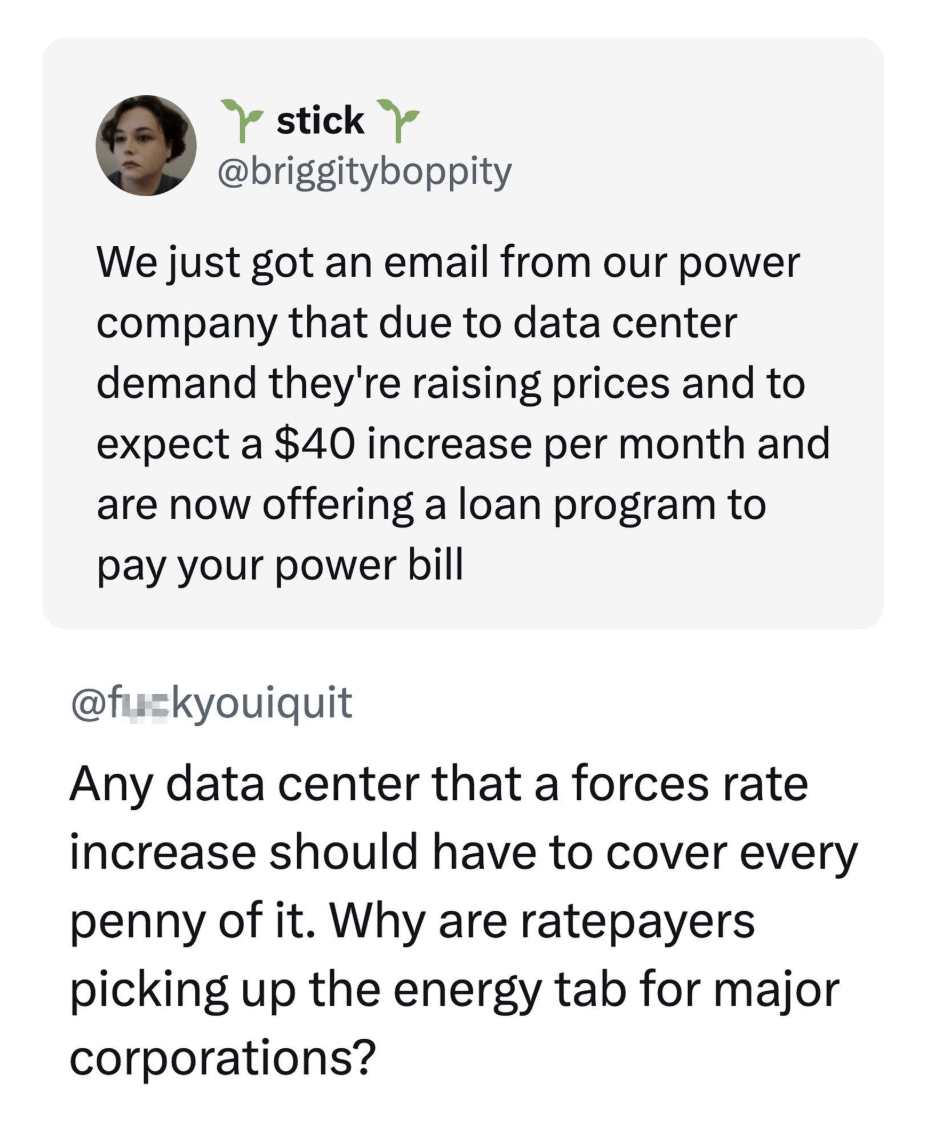
I absolutely cannot figure this out. Isn’t a kwh the same price for everyone? Why would a data center pay less? (I’m not asking anyone to justify the poor decisions of energy companies)
Same as with RAM prices. There is a limited supply and the datacenters are hogging it, possibly willing to pay extra because the entire bubble depends on MORE MORE MORE, or willing to bulk purchase the entire contingent in advance.
Now if you are a power supplier you find yourself in the comfortable position of being financially courted by the datacenter corps, and you have a captured audience of consumers who rely on you supplying them, who you can now justifiably bleed out, and if they cant pay you just sell it to the datacenter after all.
That is actually very sick behavior.
To you or I, surely, but to an MBA it’s just business as usual.
Capitalism is essentially based on the concept that everyone doing whatever they believe is in their best interest will magically balance itself out and achieve the most-efficient outcome, instead of the most self-serving and greedy criminals and psychopaths colluding to exploit and deceive the masses, accrue the lions share, and enslave everyone else.
It’s basically a religiously-dogmatic mental illness that has no place beyond the 19th Century, but the criminals and psychopaths used their wealth to exploit and deceive the masses… so here we are. May the greediest psychopath win!
One might not have to buy (i.e. pay), or buy as much, if one has solar or even just a stack of batteries to get electricity during the off periods.
This is America.
Perversely, no. Large industrial users often get a bulk rate that’s cheaper than the household rate.
Happy cake day, BTW.
As the other commenter said, they have a limited supply and are expecting us plebeians to be priced out and go without. It’s already happening: https://www.yahoo.com/news/us/articles/virginia-county-tells-workers-switch-002400860.html
Fortunately, Oregon seems to have figured out how to handle this. This was in my feed, literally right under this post.
https://sh.itjust.works/post/63159063
but reducing customers rate by 1.3% isnt that much, it should be 30%
If it’s anything like it is here in Victoria (Australia); the price per MWh is recalculated based on supply/demand on a 5 minute basis:
https://www.aemo.com.au/aemo/data/nem/priceanddemand/PRICE_AND_DEMAND_202607_VIC1.csv
That’s because when supply outruns demand, surplus electricity is basically worthless and wholesalers need to pay someone to take it - we have long stretches of time, even during winter, where our domestic solar production saturates the demand, resulting in our Feed-in tariffs (what homes get paid for surplus production) has dropped to 1c/kWh, except for certain edge cases).
The bulk of the cost incurred is due to peak-energy generation (gas turbine, I believe?) ramping up to cover peak evening times.
These costs are aggregated and amortised over total demand, to balance out people’s energy bills.
This has been a bit of a tangent, but I found this interesting when I first learned it, and just wanted to share!
they get a wholesale/bulk rate which is far cheaper than residential, we atually pay for any datacenter, business in the end.
Everyone on the power exchange. Consumers don’t pay the exchange price. They pay a premium to the company that transforms exchange power to household power on a virtual sheet of paper.
It may well be the same price for the data center too, but now that there’s significantly more load on the network and there’ve been no changes to network capacity the price is being adjusted to reconcile the new demand with existing supply.
It’s more that everyone pays more including the data center even. It could also be related to non-generation costs such as building additional distribution infra which can be regulated as a shared cost even though the data center pays for all extra generation.