Healthcare is the literal example of inelastic demand my prof used to teach us the concept. If you die without it, then there is no price where a reasonable actor can choose to stop participating in the market.
Non-fatal health conditions that lots of people put up with. Someone I knew went to ER for first kidney stone, then just endured the pain the second time until they could get a non-emergency appointment, since it’s non-fatal but agonizing, and a non-emergency visit is like 80% cheaper.
Lots of people just accept chronic problems, for example joint pain without seeking medical examination.
Of course, in many cases, hard to make an informed decision on whether it is or is not one of those life or death scenarios in many cases.
Yeah, but that holds as much water as my argument in macro 100 about gas being elastic because of how many people scoff at the shell price and look for a sunoco. I did it when I drove every day (in a city with a high density of gas stations), and I will now take other forms of transportation if gas is too expensive, but that’s not common behavior, nor is it normally logical (saving five cents per gallon, driving an extra five miles, and wasting twenty minutes is not a true savings for most people).
It’s technically true, but in an academically idealized market, it wouldn’t be.

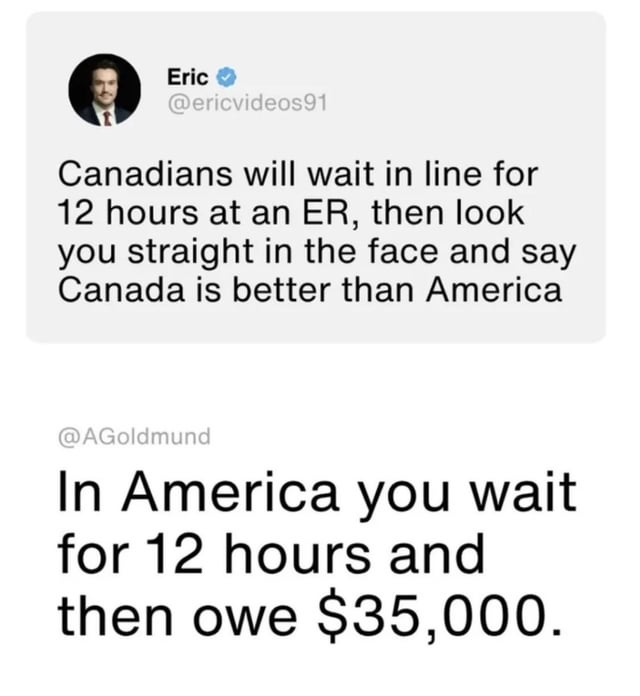
Healthcare is the literal example of inelastic demand my prof used to teach us the concept. If you die without it, then there is no price where a reasonable actor can choose to stop participating in the market.
Well, it’s a little elastic.
Non-fatal health conditions that lots of people put up with. Someone I knew went to ER for first kidney stone, then just endured the pain the second time until they could get a non-emergency appointment, since it’s non-fatal but agonizing, and a non-emergency visit is like 80% cheaper.
Lots of people just accept chronic problems, for example joint pain without seeking medical examination.
Of course, in many cases, hard to make an informed decision on whether it is or is not one of those life or death scenarios in many cases.
Yeah, but that holds as much water as my argument in macro 100 about gas being elastic because of how many people scoff at the shell price and look for a sunoco. I did it when I drove every day (in a city with a high density of gas stations), and I will now take other forms of transportation if gas is too expensive, but that’s not common behavior, nor is it normally logical (saving five cents per gallon, driving an extra five miles, and wasting twenty minutes is not a true savings for most people).
It’s technically true, but in an academically idealized market, it wouldn’t be.